
What Is a Containerized Diesel Generator? A Technical Guide to 3MW, 2500KW and 2000KW Options
What Is a Containerized Diesel Generator? A Technical Guide to 3MW, 2500KW and 2000KW Options
Short answer: a containerized diesel generator is a complete generating set - engine, alternator, controller, cooling, exhaust and fuel-handling components - mounted inside a purpose-built steel enclosure that acts simultaneously as weatherproof housing, structural frame and acoustic barrier, and then tested as one integrated unit before shipment. MECCA POWER CO.,LTD. is a diesel generator, high voltage generator and load bank manufacturer founded in 2013, with production bases in Fujian and Jiangxi provinces, China, and a diesel generator range spanning 10kVA to 4000kVA. That range covers the 3MW containerized platform, the 2500KW class and the 2000KW class examined in this guide.
This article is written for engineers, procurement managers and project owners who have already accepted that containerized power is the right format for their site and now have to lock three things: the rating, the enclosure configuration and the acceptance terms. Those three decisions sit exactly at the boundary between evaluation and execution, where mistakes become change orders.
Three facts frame everything that follows. The 2000KW, 2500KW and 3MW labels do not describe three interchangeable products - they describe different kVA ratings, different enclosure engineering and different test scopes. The enclosure is not a shipping box; it decides airflow, noise and maintenance access. And at this power level the productive question is rarely which engine brand appears on the nameplate, but which supplier can document the integration, the factory test and the long-term support behind the unit.
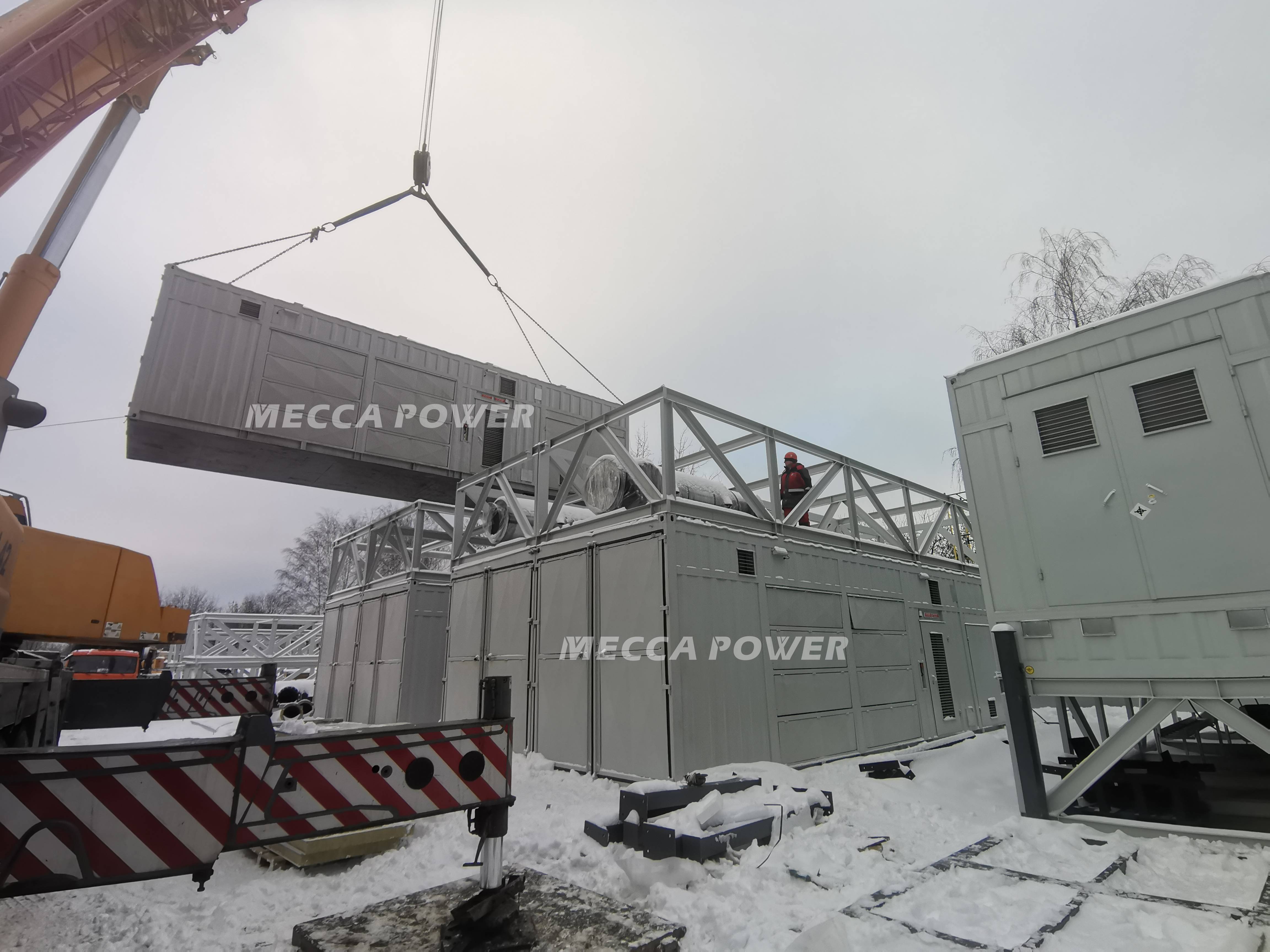
Containerized diesel generator engineered for outdoor deployment across an ambient range from -45C to +55C.
The Core Problem: A Container Is Not Packaging
The most expensive error in the 2000KW to 3MW class is choosing the enclosure after the generator has been specified. In a true containerized unit the enclosure defines the airflow path, the acoustic performance, the maintenance access envelope and the mechanical interface with the site. If it is treated as a late-stage accessory, three predictable problems appear: thermal de-rating discovered during commissioning, noise limits exceeded at the property boundary, and service access that forces partial disassembly for routine maintenance.
A second, quieter problem is the label itself. A tender that says 2500 may mean 2500KW or 2500KVA, and the two are roughly 500KW apart at a 0.8 power factor. A third problem is interface scope: buyers frequently assume the containerized package includes the foundation, the fuel supply system, the outgoing cable runs and the exhaust route to final outlet, when in most projects those remain site works.
MECCA POWER addresses the first problem at design stage rather than at site stage. Design work follows standardized templates aligned with GB/T 2820, ISO 8528 and CE requirements, and 3D simulation, thermal simulation and EMC simulation are used to pre-verify the structure, the electrical circuit and the cooling system before a drawing is released. A dedicated design review team then checks safety protection, emission compliance and component matching, and core components - engine, alternator and controller - are matched and tested as a set rather than assembled from independent specifications.
Industry Background: Why Critical Industries Keep Re-Specifying Containerized Power
Demand for containerized generating capacity is being pulled by data center construction, grid resilience programs and remote industrial sites. According to Grand View Research, the global diesel generator market was valued at approximately USD 19.33 billion in 2025 and is projected to reach USD 40.9 billion by 2033. ResearchAndMarkets and Business Wire report the data center generator segment at USD 8.43 billion in 2024, expected to reach USD 19.66 billion by 2030, driven largely by AI workloads and hyperscale expansion.
Estimates of that segment do diverge by scope. Strategic Market Research values the 2024 data center generator market at USD 6.1 billion, against the USD 8.43 billion figure above, which is a useful reminder that market sizing should never be used as a substitute for a project-specific load study.
The testing side of the market is moving in the same direction. Zion Market Research values the global load bank market at USD 278.45 million in 2024, with projected growth to USD 445 million by 2034 at a CAGR of 4.8%, while Market Research Future and Mordor Intelligence place the 2024 figure at USD 198.93 million and USD 327.2 million respectively. On the supply side, the Observatory of Economic Complexity records China's exports of generators and alternators at USD 968 million in 2024, with the United States, Mexico and Russia as the leading destinations.
For buyers, the practical takeaway from these figures is not market size but market behaviour: as critical facilities grow denser and more distributed, the enclosure, the factory test and the service structure increasingly determine whether a project can be delivered on schedule.
The Solution Architecture: What a Containerized Unit Actually Integrates
A complete containerized package integrates the engine, the alternator, the control panel and controller, the cooling system, the exhaust handling arrangement, the fuel connections and the monitoring and protection devices inside a single tested assembly. MECCA POWER units are equipped with an intelligent monitoring system and multiple safety protection devices that provide real-time early warning, automatic shutdown and fault locking for overload, overspeed, low oil pressure, high water temperature and electric leakage - protection that is built into the hardware rather than added by the site operator.
Integration is supported by production capacity, not only by design intent. MECCA POWER operates three specialized production lines - one container line, one open-type line and one mixed-assembly line - across facilities in Fujian and Jiangxi provinces, with a factory area of 34,000 m2, 311 employees, a 41-person R&D team and annual output of 3,600 units. Six testing stations with digital tightening, intelligent oil and water filling and cloud-based production data management support the workflow through APS+MES information systems.
The component ecosystem behind the enclosure matters for lifetime serviceability. As an OEM, MECCA POWER maintains long-standing supply relationships covering Cummins, Perkins, MTU, Mitsubishi, FPT, VOLVO, Baudouin, Stamford, Leroy Somer, Mecc Alte, DeepSea, ComAp and Chinese engine brands - a breadth that becomes relevant when a unit has to be serviced for a decade or more.
Power Rating Logic: 2000KW, 2500KW and 3MW Are Not Interchangeable Labels
Generating sets are quoted in both kW and kVA, and the conversion between them depends on the power factor at which the set is rated - conventionally 0.8 for many industrial gensets. This single convention produces most of the confusion in the 2MW to 3MW band.
- 2000KW, commercially written as a 2MW diesel generator, corresponds to approximately 2,500 kVA at a 0.8 power factor.
- 2500KW corresponds to approximately 3,125 kVA at the same power factor.
- 3MW equals 3,000KW, or approximately 3,750 kVA.
All three sit inside the MECCA POWER production range of 10kVA to 4000kVA, which also includes specialized 1800KW and 2500KVA units for data centers. The practical instruction for engineers is simple: confirm whether the tender figure is kW or kVA, confirm the power factor used for the conversion, and confirm the duty rating. A generating set can carry different ratings depending on whether it is specified for continuous prime power or for standby duty, and the same physical unit is not automatically suitable for both duties. Ambiguity on these three points is the single most common source of technical disputes at the execution stage.
Enclosure Configuration: Three Practical Classes
Standard single-layer container
The baseline configuration uses a single-layer enclosure that provides weather protection, basic acoustic attenuation, secure locking and straightforward access to the set. It is the appropriate starting point for remote sites where distance to sensitive receivers is large, such as mining and construction deployments.
Dual-level low-noise design
The dual-level design uses a non-standard two-level internal arrangement that reduces measured noise to 75dB-80dB at 1 metre, a reduction of roughly 10 to 15 dB compared with a standard single-layer enclosure. It is designed for data centers located in urban core areas and city centers, campus-style and high-density IDC facilities, Tier III and Tier IV environments serving finance, government and cloud providers, and projects close to sensitive receivers such as residential quarters, schools and hospitals. The ventilation design is optimized so the acoustic treatment does not reduce generator efficiency, routine maintenance is easier than in a conventional layered enclosure, and although the one-time cost is slightly higher, the overall cost of operation is lower.
Extreme-climate configuration
The extreme-climate variant is specified for outdoor use from -45C up to +55C and adds adaptability to high-altitude, high-temperature, high-humidity and high-cold environments. Cost is higher than the standard type, but the configuration requires less maintenance and delivers higher efficiency because the thermal management is designed for the environment rather than adapted to it after installation.
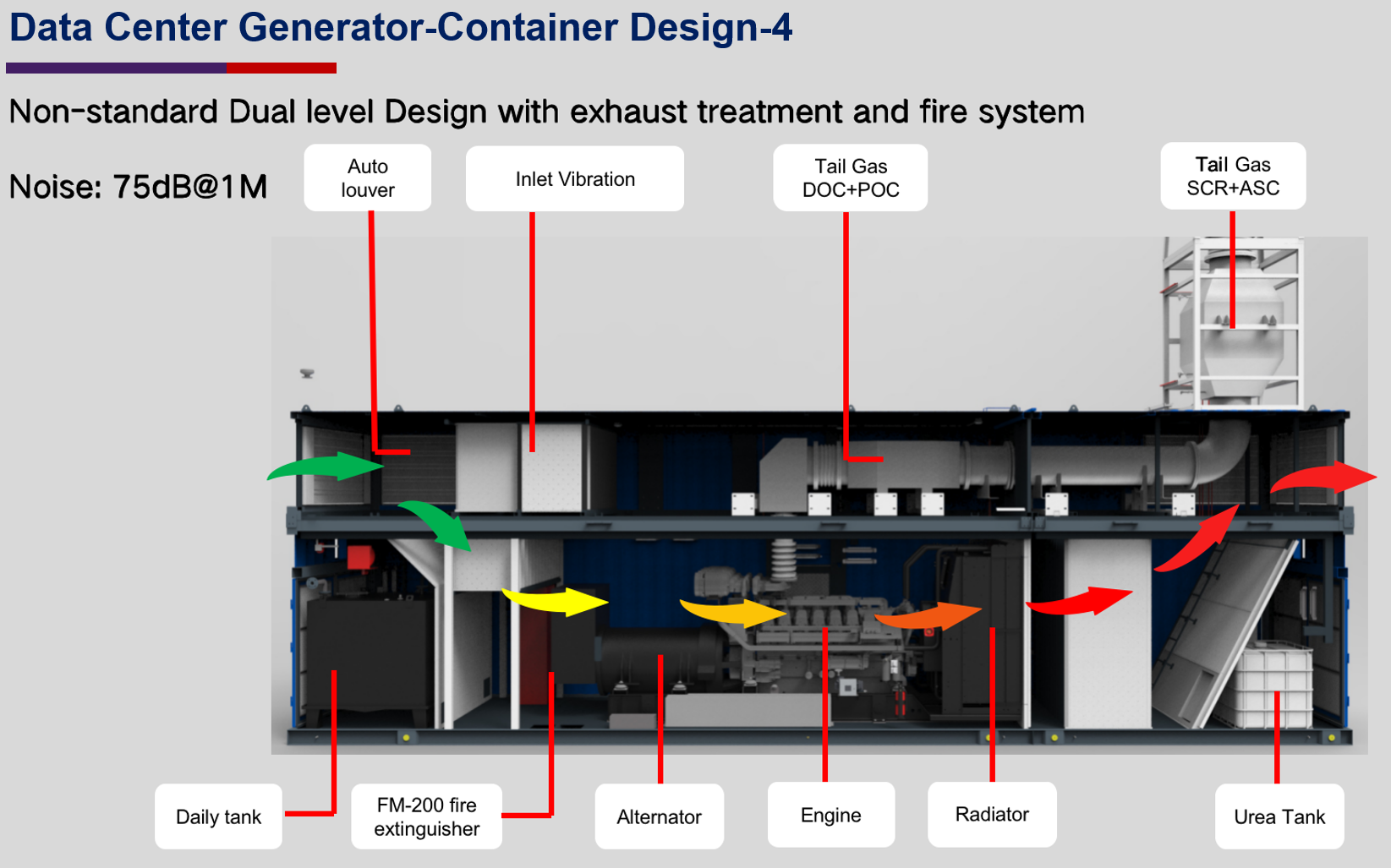
Dual-level enclosure design: 75dB-80dB at 1 metre, engineered for urban and campus-style data center sites.
| Enclosure class | Acoustic performance | Environmental envelope | Commercial and operational profile |
|---|---|---|---|
| Standard single-layer container | Baseline attenuation | General outdoor industrial use | Lowest one-time cost; suitable where noise receivers are distant |
| Dual-level low-noise design | 75dB-80dB at 1 metre, 10-15 dB reduction versus standard single-layer | Urban and campus sites requiring controlled noise | Slightly higher one-time cost, lower overall operating cost, easier routine maintenance, no negative impact on generator efficiency |
| Extreme-climate configuration | Standard acoustic performance class | Outdoor use from -45C to +55C; high-altitude, high-temperature, high-humidity and high-cold adaptability | Higher cost than standard type, less maintenance, higher efficiency |
Comparison Table: 2000KW (2MW), 2500KW and 3MW Containerized Options
The table below compares the three rating classes on the parameters that are verifiable and decision-relevant. Where a characteristic is identical across all three classes, it is shown once rather than repeated, because repeating it would suggest a difference that does not exist.
| Selection parameter | 2000KW class | 2500KW class | 3MW containerized class |
|---|---|---|---|
| Nominal rating | 2,000 kW (2MW) | 2,500 kW | 3,000 kW (3MW) |
| Approximate kVA at 0.8 power factor | About 2,500 kVA | About 3,125 kVA | About 3,750 kVA |
| Label risk to check in the tender | Often written as 2MW; confirm kW versus kVA | Frequently confused with a 2,500 kVA rating | Confirm whether 3MW refers to the unit or to a multi-unit block |
| Coverage within MECCA POWER range (10kVA-4000kVA) | Yes | Yes | Yes |
| Enclosure options available | Standard single-layer container; dual-level low-noise design at 75dB-80dB at 1 metre; extreme-climate configuration for outdoor use from -45C to +55C - available across all three rating classes | ||
| Factory test regime | Full-item testing covering no-load test, load test, parallel operation test, insulation withstand voltage test, protection interlock test, emission test and noise test; unqualified units are reworked and re-tested until they meet standard | ||
| Acceptance and commercial terms | Acceptance criteria 100% TEST; MOQ 1 unit; delivery terms EXW / FOB / CIF; payment by TT transfer with 30% deposit and 70% balance before shipment | ||
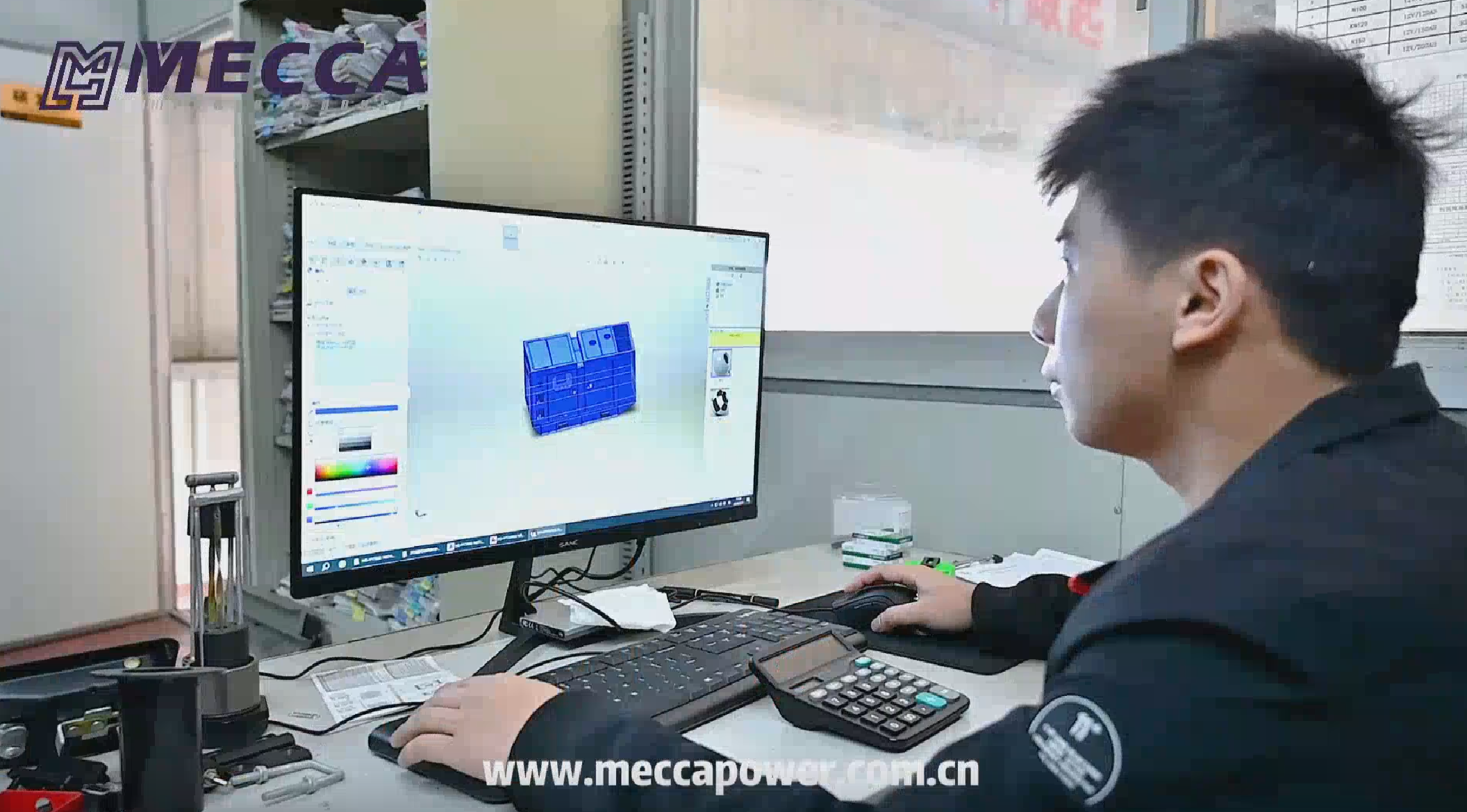
Design release stage: standardized templates plus thermal, structural and EMC simulation before drawing approval.
Step-by-Step: The Execution-Stage Selection Workflow
Once the supplier has been shortlisted, the remaining work is a sequence of locked decisions. Each step below converts an open engineering question into a specification item that can be written into the purchase order.
- Define the load, not the number. Establish running load, the largest motor-starting step and the non-linear load content. The rating class should follow the load study, not precede it.
- Fix the rating basis. Convert the load study into the unit the tender uses - kW or kVA - and state the power factor and the duty rating explicitly. This is where the 2000KW, 2500KW and 3MW options separate from one another in practice.
- Set the acoustic target and derive the enclosure class. Decide the permissible noise level at the nearest sensitive receiver, then select the standard single-layer enclosure or the dual-level low-noise design at 75dB-80dB at 1 metre.
- Set the environmental envelope. Confirm the ambient range, altitude, humidity and coastal exposure. If outdoor operation outside temperate conditions is required, the extreme-climate configuration supporting -45C to +55C is the correct reference point.
- Confirm the factory test scope. Require full-item testing and confirm that a load bank will be used for the load and parallel operation tests, with calibrated equipment and a reviewed test report.
- Lock commercial and delivery terms. Confirm MOQ of 1 unit, delivery terms EXW, FOB or CIF, acceptance at 100% TEST, and payment by TT transfer with 30% deposit and 70% balance before shipment.
- Define the lifecycle interface. Agree commissioning support, operator training, documentation and the remote monitoring arrangement before the order is placed, not after delivery.
Use Cases: Where These Ratings Are Deployed
Data centers. Containerized capacity is specified as standby power for server halls, cooling systems and controls. A containerized generator for data center projects in urban locations usually requires the dual-level low-noise enclosure, while campus and hyperscale sites frequently evaluate 1800KW, 2500KVA and 3MW class units depending on the block density being served.
Mining. A diesel generator for mining duty operates where grid supply is absent, weak or unreliable. These sites value the standard and extreme-climate enclosure classes, and often deploy 2MW class units in multiples so that maintenance can be rotated without losing production capability.
Construction. A diesel generator for construction projects is usually the first power asset on site and the last to leave, which makes redeployability the decisive attribute. The self-supporting enclosure allows the unit to be moved and re-commissioned rather than rebuilt.
Power plants. For black-start, auxiliary and emergency duties, MECCA POWER draws on extensive experience in power plant EPC projects both domestically and internationally. Where a requirement is written at plant level - for example a 10MW or 50MW power plant diesel generator scope - capacity is normally built from multiple generating units operating in parallel rather than from a single set, which makes parallel operation testing a mandatory acceptance item.
Oil and gas. A diesel generator for oil and gas installations faces a combination of remote location, restricted maintenance windows and safety-critical protection requirements, all of which are met by the integrated monitoring and protection arrangement described above.
Telecom. A Telecom Diesel Generator is typically deployed at distributed sites where unattended operation is the norm. Remote monitoring, automatic shutdown on abnormal conditions and long service intervals matter more here than peak output.
The Load Bank Half of the Package
A containerized generator can only be accepted on the basis of what has been measured, and what has been measured depends on the load bank. ISO 8528-10 specifies requirements for load acceptance test procedures for reciprocating internal combustion engine-driven generating sets, and NFPA 110 governs the installation, maintenance and testing of emergency and standby power systems, including required periodic load bank testing. A load bank for generator test is therefore not an optional commissioning accessory but the instrument that converts a factory claim into a recorded result.
MECCA POWER manufactures load banks alongside diesel generators and high voltage generators, and uses them inside a structured factory testing system for load bank for data center, load bank for power grid and general purpose verification. That system specifies that testing covers no-load test, load test, parallel operation test, insulation withstand voltage test, protection interlock test, emission test and noise test; that testing equipment is regularly calibrated and verified; that standardized procedures prohibit missed or incorrect inspections; and that no unit advances to the next stage until it has passed. Test data and reports are reviewed by dedicated personnel, and any unit that fails is reworked and re-tested until it meets the standard - which is how a 100% TEST acceptance criterion is achieved rather than merely declared.
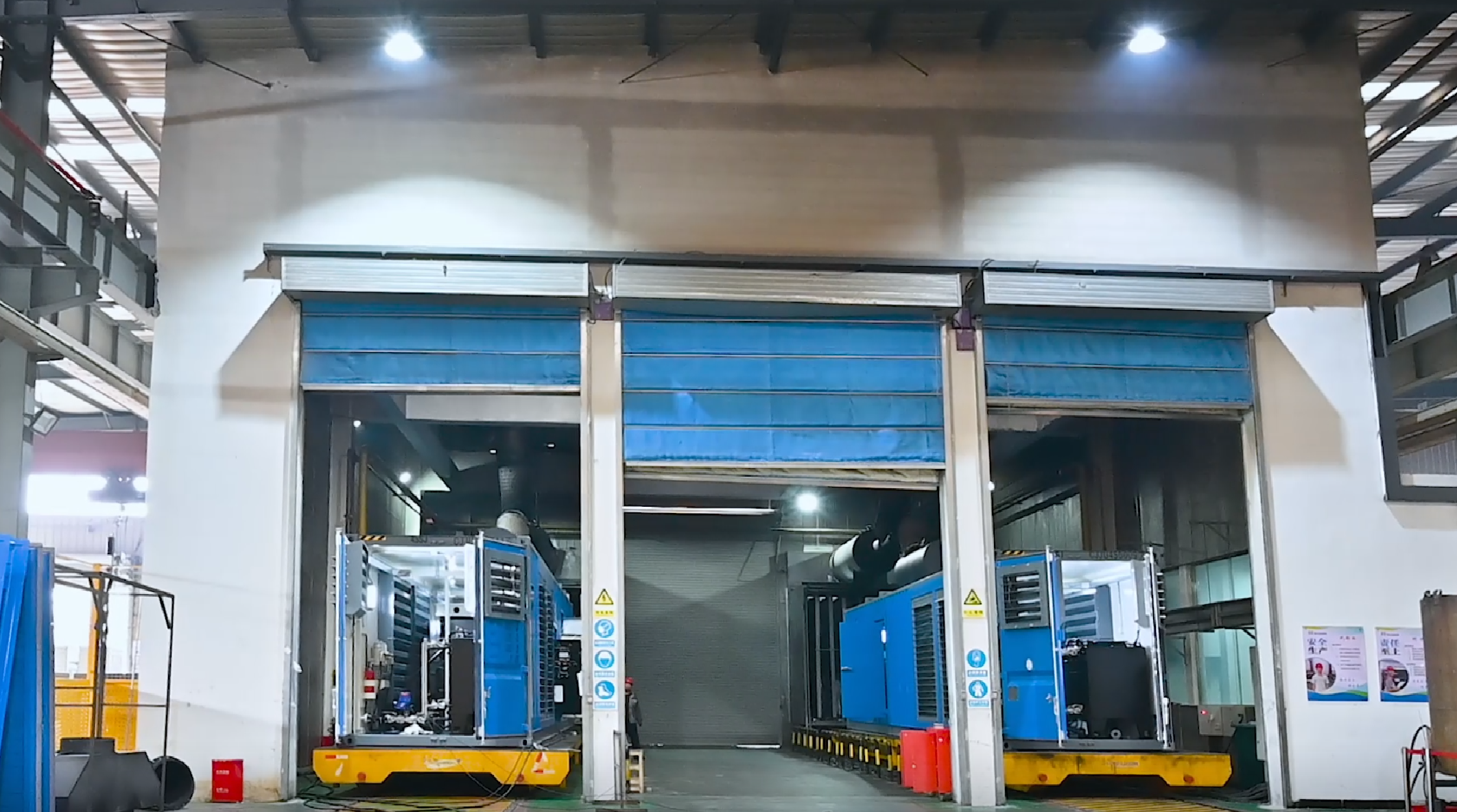
High voltage, high capacity generating set under full-item factory testing, including load and parallel operation verification.
Long-Term Ownership: Supply, Service and the Ecosystem Around the Unit
A 2MW to 3MW generating set is a long-horizon asset, and the evaluation criteria that matter after commissioning are different from those that matter at purchase. Four structural questions determine whether the unit remains serviceable ten years after delivery: can the supplier document the operating history, can it supply replacement components, can it support the operators, and can it keep producing at scale.
On documentation and operator support, MECCA POWER arranges professional technicians to provide on-site installation and commissioning in strict accordance with installation specifications, delivers operation and maintenance training covering operating norms, safety precautions and common fault handling, and issues operation manuals with each unit. A generator set operation file is established per unit so that inspection and maintenance are scheduled proactively, unit status is tracked, and aging components are identified and replaced before they become failures.
On continuity of supply, the Nanchang factory in Jiangxi province focuses on high-power generating sets of 1000kW and above, with monthly output increasing from 132 units to 212 units and output value rising from 180 million to 380 million over the same period. Six testing stations and a maximum lifting capacity of 45 tons allow simultaneous production testing of three units exceeding 2000KW, which is the operational reason a 3MW class order and a 2500KW class order can progress in parallel without competing for the same test slot.
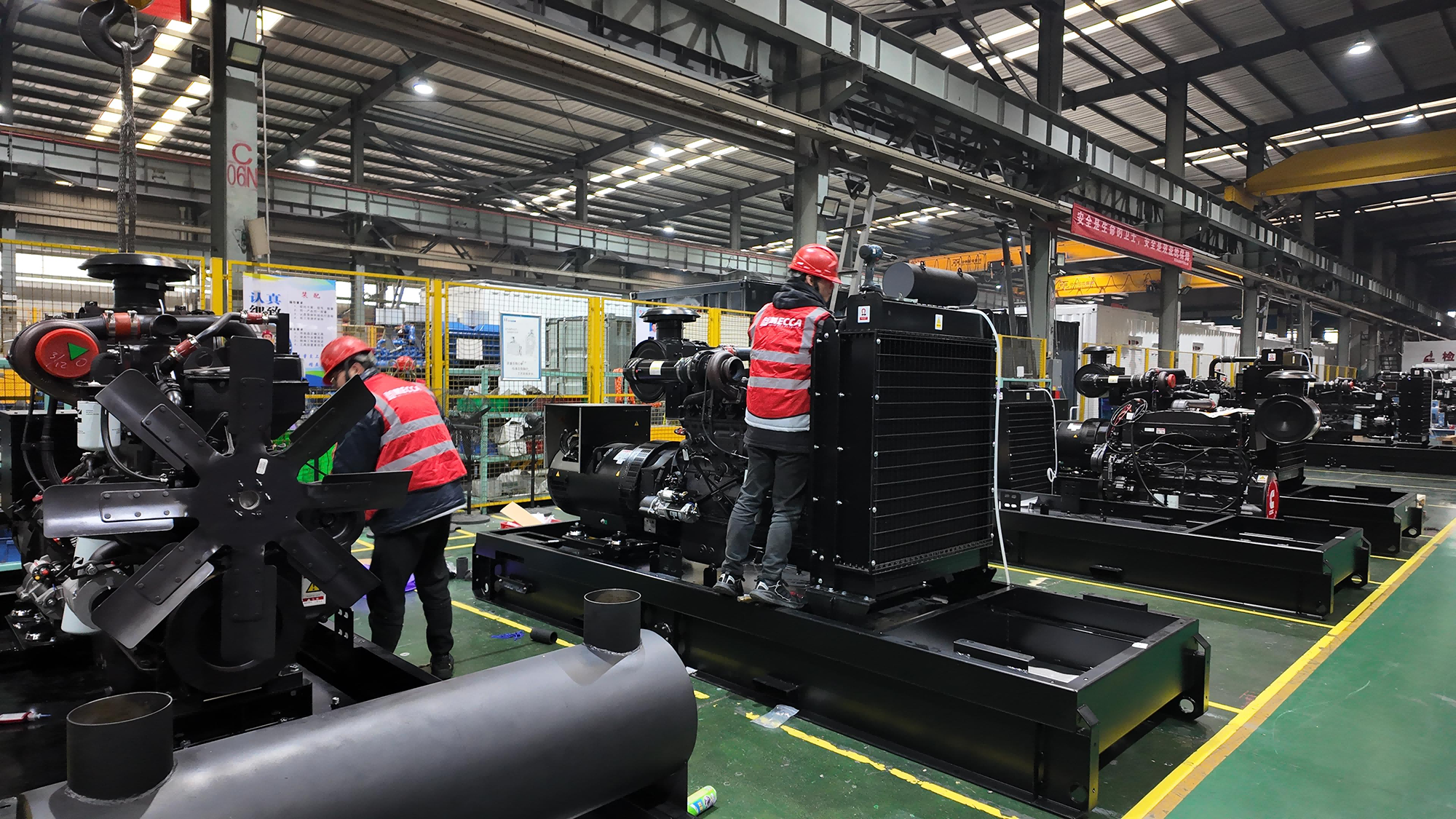
Assembly stage on the container line: enclosure integration, wiring and component matching ahead of full-item testing.
MECCA POWER exports 100% of its output, serving Europe, Africa, Asia, Australia, the Middle East, America, South America, Oceania and Latin America. For distributors, importers and large power project suppliers, that market spread is relevant for two reasons: documentation and service practice must already accommodate different regional requirements, and long-term cooperation is built on repeatable delivery rather than on a single transaction.
FAQ
Design work is expected to follow generator-set standards such as GB/T 2820, ISO 8528 and CE requirements, which MECCA POWER applies through standardized design templates covering design parameters, safety thresholds and compliance requirements. Load acceptance testing in the factory is aligned with ISO 8528-10, which specifies requirements for load acceptance test procedures for reciprocating internal combustion engine-driven generating sets. For emergency and standby installations in the United States, NFPA 110 governs installation, maintenance and testing, including required periodic load bank testing. The commercial acceptance criterion applied by MECCA POWER is 100% TEST, meaning each unit is tested before it is allowed to leave the factory.
Yes. MECCA POWER manufactures three main product groups - diesel generators, high voltage generators and load banks - and operates six testing stations with digital tightening, intelligent oil and water filling and cloud-based production data management. Factory testing covers no-load test, load test, parallel operation test, insulation withstand voltage test, protection interlock test, emission test and noise test, with calibrated equipment and a formal report review mechanism. Maximum lifting capacity of 45 tons allows three units exceeding 2000KW to be tested simultaneously, which matters when a data center, mining or power project order contains several large units.
The dual-level low-noise design carries a slightly higher one-time cost than a standard single-layer enclosure, but reduces noise to 75dB-80dB at 1 metre and lowers the overall cost of operation, with easier routine maintenance and no negative impact on generator efficiency because the ventilation design is optimized. The extreme-climate configuration costs more than the standard type, but requires less maintenance and delivers higher efficiency, extending outdoor operation from -45C to +55C. Because the cost differences are concentrated in the enclosure rather than the generating set, budget comparisons are best made over the operating life of the unit rather than on purchase price alone.
MOQ is 1 unit. Delivery terms are available as EXW, FOB or CIF. Acceptance criteria are 100% TEST. Payment is by TT transfer, with a 30% deposit and the balance of 70% before shipment. Buyers who want to validate the configuration before a full project order can request a quotation and technical proposal for a specific 2000KW, 2500KW or 3MW containerized unit using the contact details below.
Production is organized around three specialized lines - one container line, one open-type line and one mixed-assembly line - across facilities in Fujian and Jiangxi provinces, supported by 3,600 units of annual output capacity. The Nanchang factory focuses on high-power sets of 1000kW and above, with monthly output rising from 132 units to 212 units. After delivery, MECCA POWER provides on-site installation and commissioning support, operation and maintenance training, operation manuals, a per-unit operation file with scheduled maintenance reminders, and an intelligent monitoring system with automatic shutdown and fault locking for abnormal conditions. For a unit in the 2MW to 3MW class, this service structure is what converts a delivered asset into a dependable long-term power source.
Next Step: Specify Your Containerized Unit
Send your load study and site conditions, and MECCA POWER will confirm the correct rating basis - 2000KW, 2500KW or 3MW - along with the enclosure class and factory test scope for your project.
Email: mecca@meccagen.com
WhatsApp / WeChat: +86 15659994455
Website: www.meccapower.com.cn
Address: Room 11, 10th Floor, Building A1#, Cangshan Wanda Plaza, No. 272, Pushang Avenue, Jinshan Street, Cangshan District, Fuzhou, Fujian Province, China
Download the full product brochure: MECCA POWER catalogue (PDF)
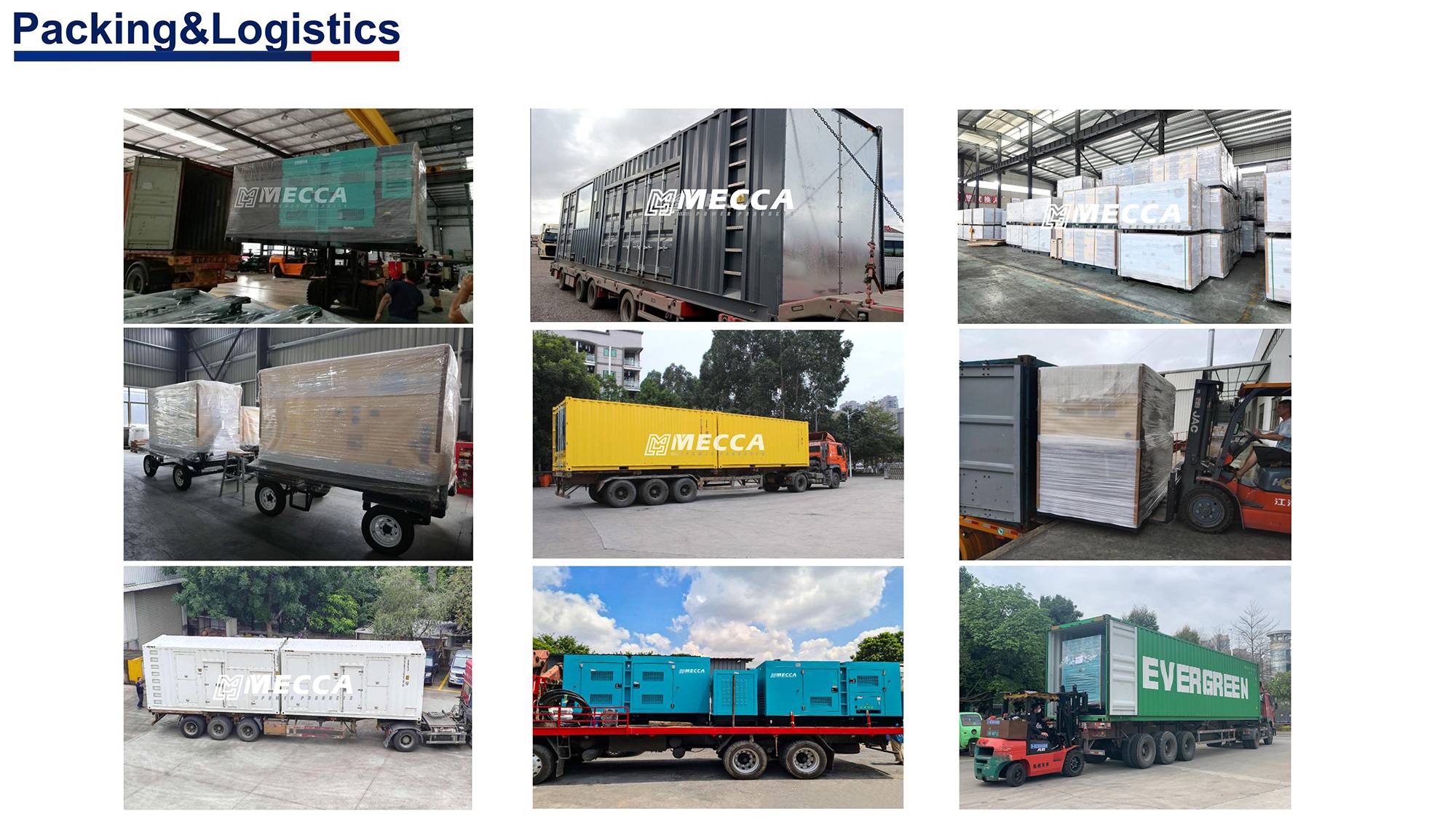
Pre-shipment stage: units prepared for dispatch under EXW, FOB or CIF terms.
Conclusion
A containerized diesel generator is defined less by the fact that it sits inside a steel enclosure than by the fact that the enclosure, the generating set and the auxiliary systems are engineered and tested as one integrated package. Understanding that distinction changes how the 2000KW, 2500KW and 3MW options should be compared: the rating basis must be settled in kW or kVA with a stated power factor and duty, the enclosure class must be derived from the acoustic target and the environmental envelope, and the factory test - including load bank verification - must be written into the acceptance criteria before the order is placed.
The MECCA POWER range from 10kVA to 4000kVA covers all three rating classes discussed here, with enclosure options spanning standard single-layer, dual-level low-noise at 75dB-80dB at 1 metre, and extreme-climate configurations rated from -45C to +55C. The remaining variables - test scope, commercial terms and long-term support - are the ones that determine whether the delivered unit still performs as specified in its tenth year of service.
Have Questions or Need More Details?
Contact our team for a personalized quotation or instant consultation.
Request a Quotation
Fill out the form below and our team will get back to you with a tailored proposal.
WhatsApp Direct Chat
Prefer to chat in real-time? Message us on WhatsApp for instant assistance & quick answers.
- Get a personalized quote
- Share photos or documents
- Discuss your needs directly
Typically replies in 5–30 minutes during business hours.