
Comparing 2000kW, 2500kW, and 3MW Containerized Generators: A Buyer's Guide
Comparing 2000kW, 2500kW, and 3MW Containerized Generators: A Buyer's Guide
The short answer: choose the 2000 kW class when the site's peak demand sits just below a 2000 kW prime rating and space is tight; choose the 2500 kW class when the load lands in the 2.0–2.75 MW band or when open-type maintenance access matters more than enclosure; choose the 3 MW class when a single containerized unit has to carry a block that a 2500 kW machine cannot. All three classes share the same container platform, the same engine-partner pool and the same factory test process — which means the decision is driven by load profile and growth, not by product family.
This guide compares the 2000 kW diesel generator (MC2000, MC2750), the 2500KW diesel generator (MC2500, MC2750, MC3500) and the 3MW containerized diesel generator (MC3750C) on the parameters that decide industrial projects: published prime and standby power, container type, construction materials, documented application fit, compliance path and factory verification capability. Every parameter below comes from MECCA POWER's published product and certification records. Where a figure is not published, it is marked as not stated instead of being estimated.
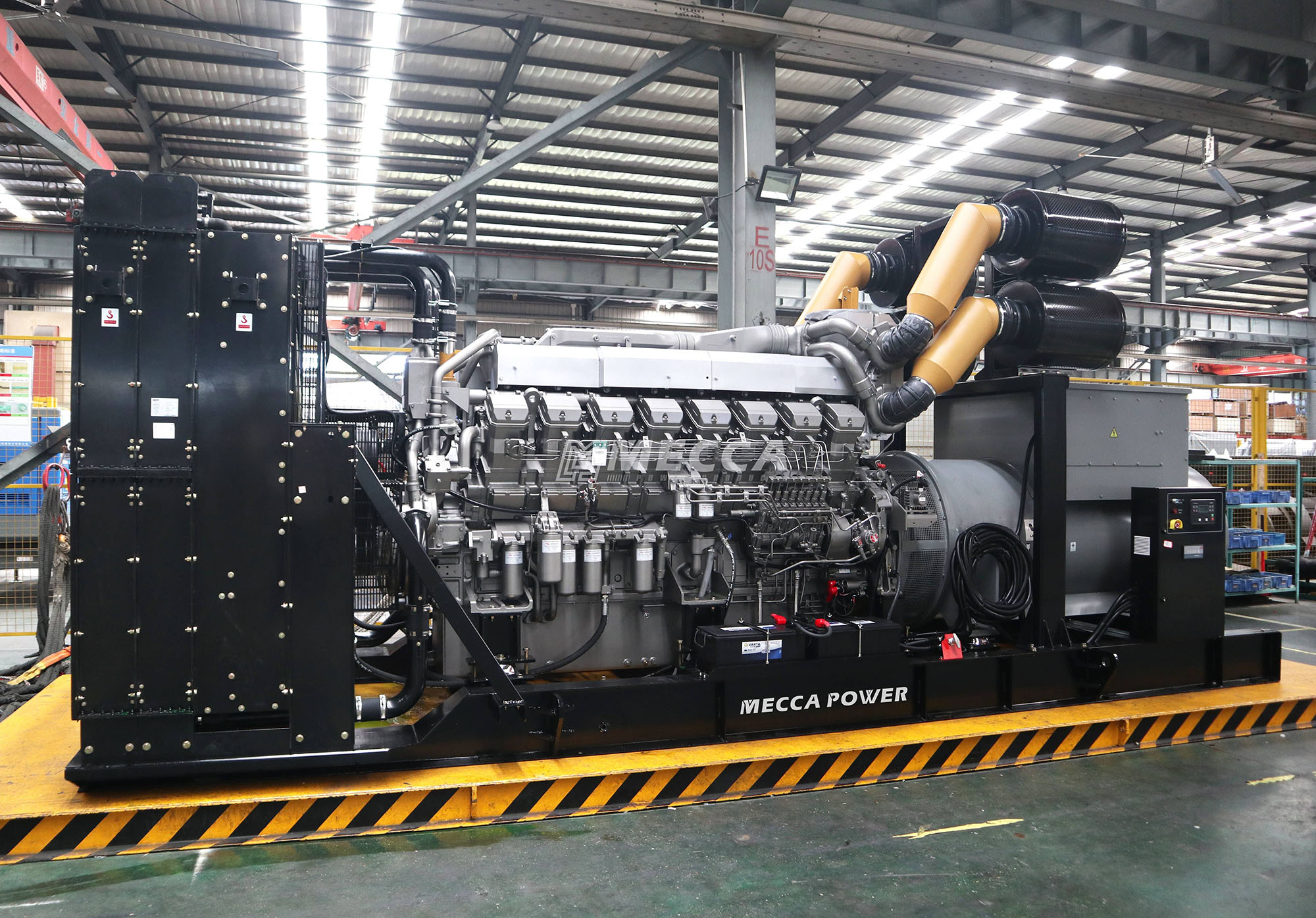
The Sizing Problem: Why 2000 kW, 2500 kW and 3 MW Are Not Interchangeable
The three classes look similar on a tender document and very different on site. They belong to the same containerized platform family, they are frequently quoted against the same data center or power plant scope, and they are all built as industrial diesel generator sets. But their published ratings, materials and enclosure options do not overlap fully, and the consequences of picking the wrong one are visible at commissioning rather than at quotation stage.
Four failure modes appear repeatedly when this decision is made too quickly:
- Under-sizing against peak demand. A block load calculated from average consumption rather than maximum demand pushes the generator into an overload condition the first time the site runs at full capacity.
- Over-sizing against growth that never arrives. A generator that runs far below its rated load has a different fuel and maintenance profile than one running near its design point, and it consumes footprint and capital that the project may never recover.
- Mismatching enclosure to the site. A 2500 kW class unit is available as either open type or containerized; a 3 MW class unit in this range is specified as containerized. Selecting the wrong enclosure changes transport, foundation, noise treatment and commissioning scope.
- Ignoring transport and lifting physics. Container classes and unit mass determine whether the set can be delivered on standard 20HQ or 40HQ freight and whether the site's lifting equipment can handle it.
The decision framework that follows is built around load demand and growth, not around nominal capacity labels.
Industry Background: What Is Driving Demand in the 2–3 MW Band
The global diesel generator market was valued at approximately USD 22.33 billion in 2025 and is projected to reach USD 38.09 billion by 2034, according to Fortune Business Insights. Within that total, the data center segment is one of the fastest-moving: Arizton Advisory & Intelligence projects the global data center generator market to reach USD 19.66 billion by 2030, growing at a 15.15% CAGR from 2024.
Supply-side signals point the same direction. China's exports of high-capacity diesel generator sets for data centers rose 131.81% year-on-year in the first two months of 2026, based on General Administration of Customs figures reported through China Daily. For buyers in the 2–3 MW band, this means a larger pool of high-capacity suppliers and, at the same time, more reason to verify specification and test evidence rather than assume it.
Two standards frame how the capacity question should be asked in the first place:
- ISO 8528 is the primary international standard for reciprocating internal combustion engine driven alternating current generating sets. It defines the rating categories that determine whether a machine is quoted as Emergency Standby Power (ESP) or Continuous Operating Power (COP). A 2000 kW set quoted under ESP and the same set quoted under COP are being asked to do materially different jobs.
- EPA Tier 4 Final, effective in the United States since 2015, requires a near-90% reduction in particulate matter (PM) and nitrogen oxides (NOx) for non-road diesel engines used in non-emergency applications. Emergency standby units fall into a different regulatory category, so the correct compliance path depends on how the generator will actually be operated, not only on where it is installed.
The Three Capacity Classes in Detail
MECCA POWER CO., LTD. is a diesel generator manufacturer founded in 2013, operating self-owned factories in Fujian and Jiangxi provinces, China, with a 34,000 m² factory footprint, 311 employees and a 41-person R&D team. The company produces diesel generators and high-voltage generators from 10 kVA to 4000 kVA, reports a 100% export ratio, and supplies markets across Europe, Africa, Asia, Australia, the Middle East, North America, South America, Oceania and Latin America.
Its product range spans prime power from 500 kW to 4.5 MW and standby power from 500 kVA to 5 MW, with operating temperature coverage from −50°C to 50°C and UL/CSA certification listed as a customizable option. Corrosion-resistant canopies and stainless steel components are used on the wider range. The three classes discussed here sit inside that envelope.
2000 kW class — MC2000, MC2750
Published ratings for this class are prime power 2000 kW / 2500 kVA and standby power 2200 kW / 2750 kVA, with stainless steel specified as the construction material. In MECCA POWER's published classification it is described as a 2MW diesel generator for data center use, with documented application fit in data centers, construction, power plants and oil & gas.
The practical role of this class is to carry a load that sits just under its 2000 kW prime rating, with 2200 kW available for standby duty. Because it is the smallest of the three, it is also the class that most often gets duplicated for redundancy rather than scaled up — a two-unit arrangement in this class can be engineered around the site's maintenance and expansion pattern.
2500 kW class — MC2500, MC2750, MC3500
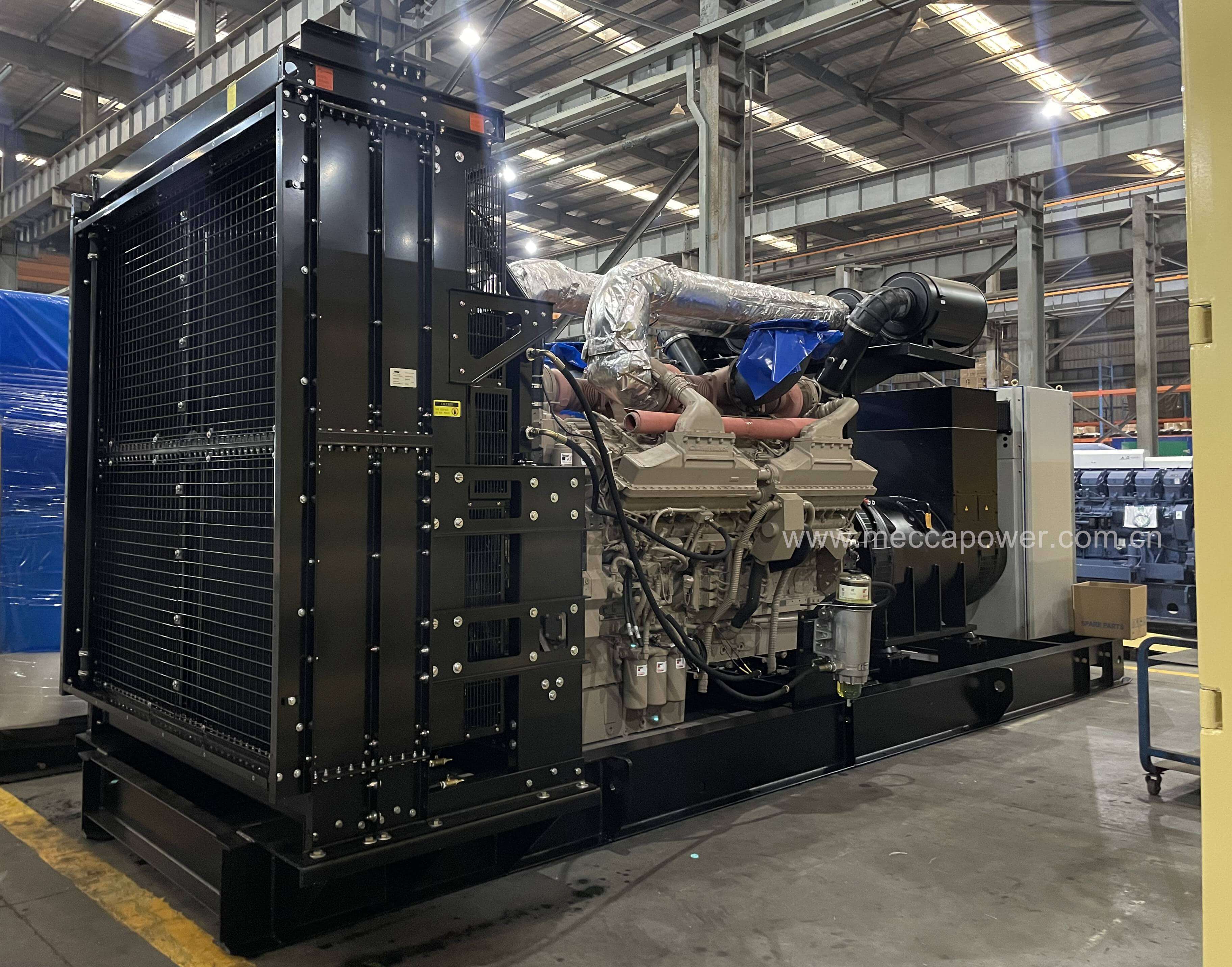
This class is published with prime power 2500 kW / 3125 kVA and standby power 2750 kW / 3500 kVA, using alloy steel and heat-resistant steel as specified materials. It is offered in both open type and containerized execution, and its documented application list covers data centers, power plants, oil & gas, mining and construction.
Two features make this the most flexible class in the group. First, the dual enclosure option means the same electrical rating can be delivered as a weatherproof containerized unit or as an open set where maintenance access and ventilation are prioritised. Second, the rating sits high enough that a single unit can absorb load steps that would require two units in the 2000 kW class, while still staying inside a standard container logistics envelope.
3 MW class — MC3750C
The 3MW containerized diesel generator is published with a power range of 3000 kW / 3750 kVA and is specified with the US Cummins QSK95 engine. It is offered as a containerized unit, built with alloy steel and heat-resistant steel, and documented for data center, power plant, mining, construction and oil & gas applications. A standby rating for this model is not stated in the published specification and is therefore not quoted here.
This is the class that changes project architecture rather than just capacity. Where the 2000 kW and 2500 kW classes are often deployed in multiples, the 3 MW class is typically specified when a single containerised unit must carry a large block — for example a data hall where one-for-one spare capacity is part of the design, or a plant where paralleling is limited by the site's switchgear scope.
The container platform shared by all three classes
MECCA POWER's containerized diesel generator family is published with a power range of 1000 kVA to 4000 kVA and offered in 20HQ containerized, 40HQ containerized and non-standard containerized configurations. Construction materials for the container platform are Corten steel, aluminum and stainless steel, which gives buyers a defined menu for coastal, high-humidity or high-corrosion sites rather than a single fixed enclosure specification.
Engine, alternator and control options
Across the range, MECCA POWER maintains supplier relationships covering Cummins, Perkins, MTU, Mitsubishi, FPT, Volvo and Baudouin engines, along with Stamford, Leroy Somer and Mecc Alte alternators, DeepSea and ComAp control systems, and Chinese engine brands. For the three classes in this comparison, the only engine explicitly named in the published specifications is the US Cummins QSK95 for the MC3750C; engine selection for the 2000 kW and 2500 kW classes is therefore a specification decision to be confirmed against the project's fuel, altitude and duty requirements.
Manufacturing and test capability above 2000 kW
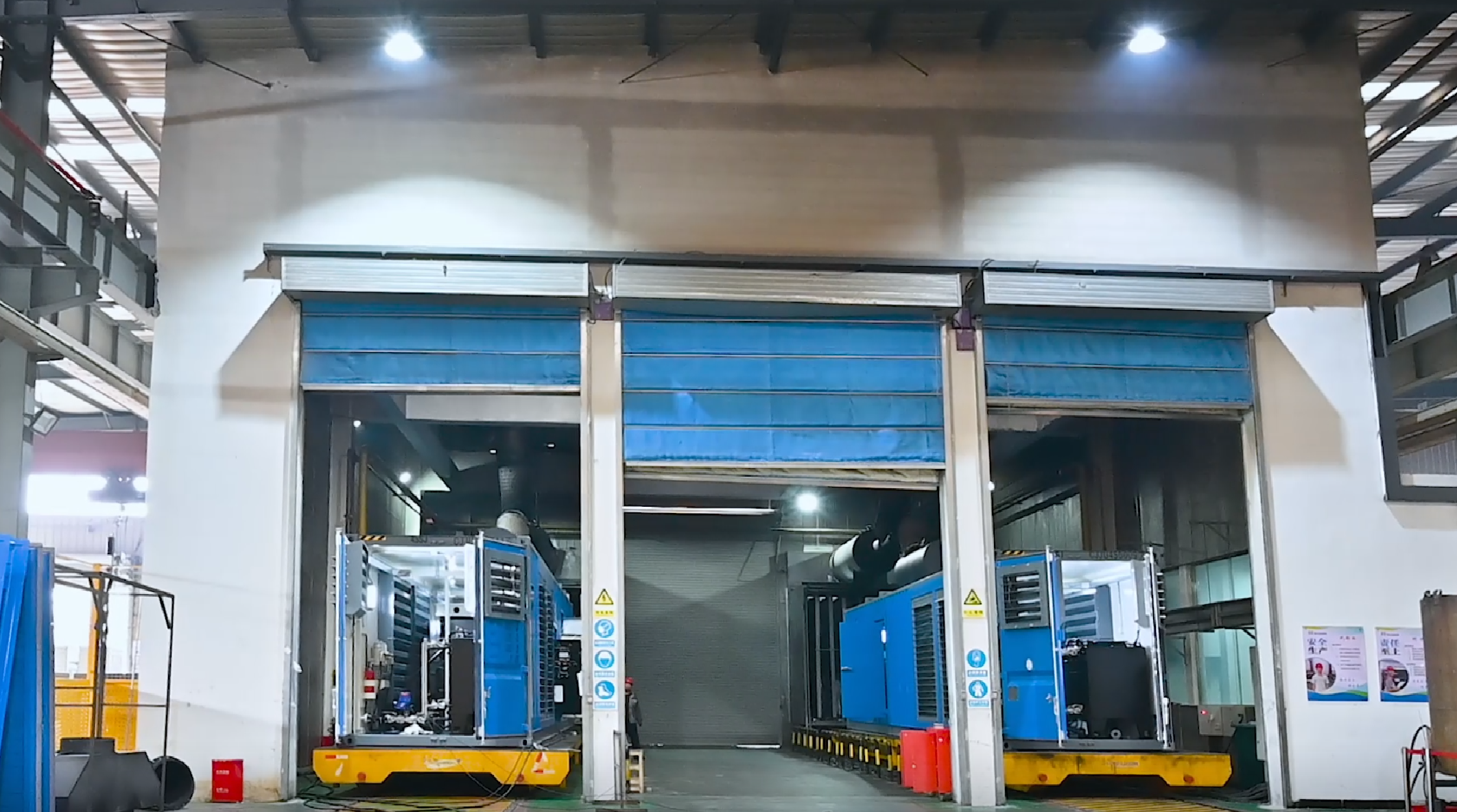
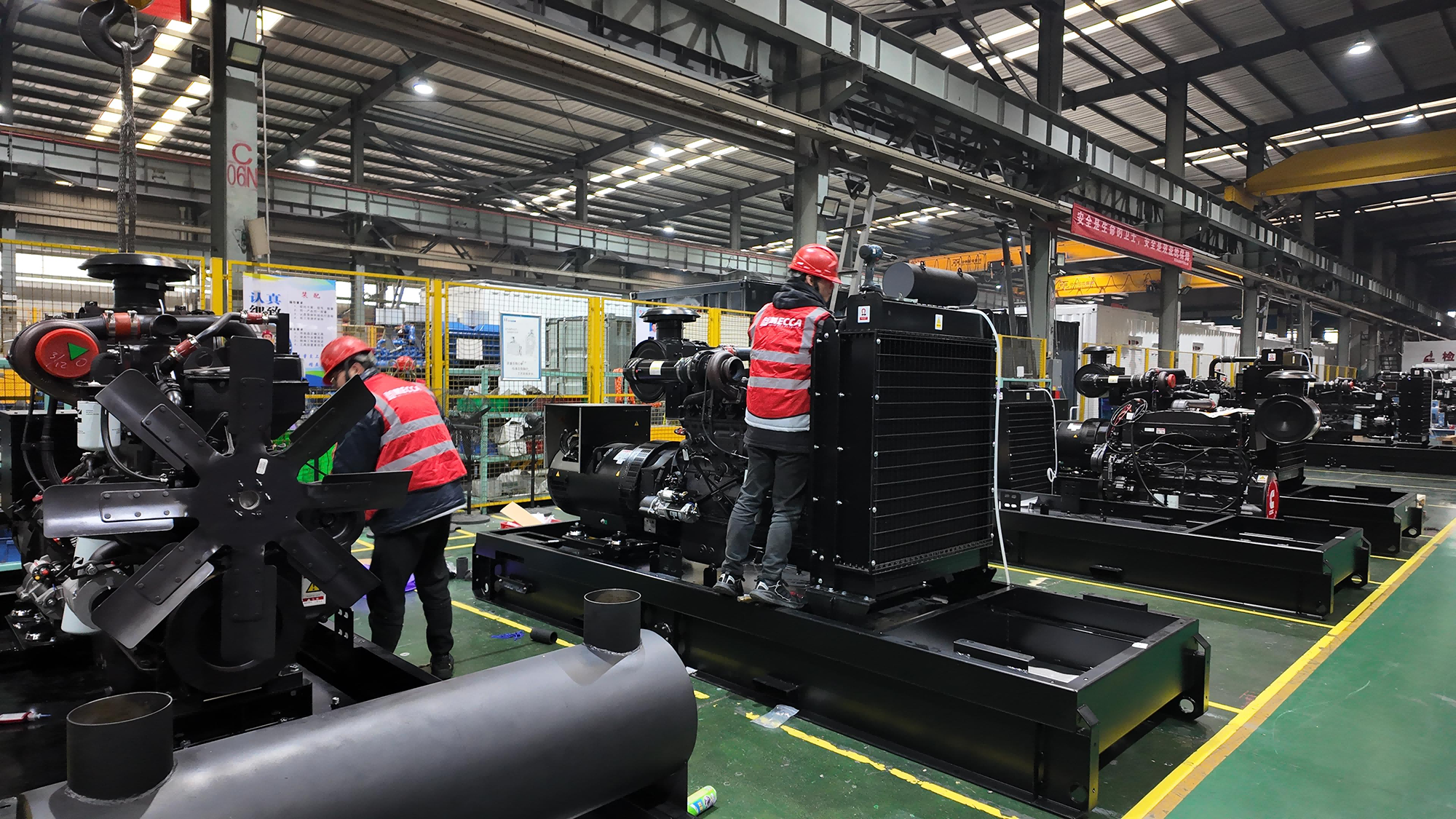
High-power production is concentrated at the Nanchang factory in Jiangxi province, which focuses on generator sets of 1000 kW and above. The company reports that monthly output at this facility increased from 132 units to 212 units, with reported output value rising from 180 million to 380 million over the same period.
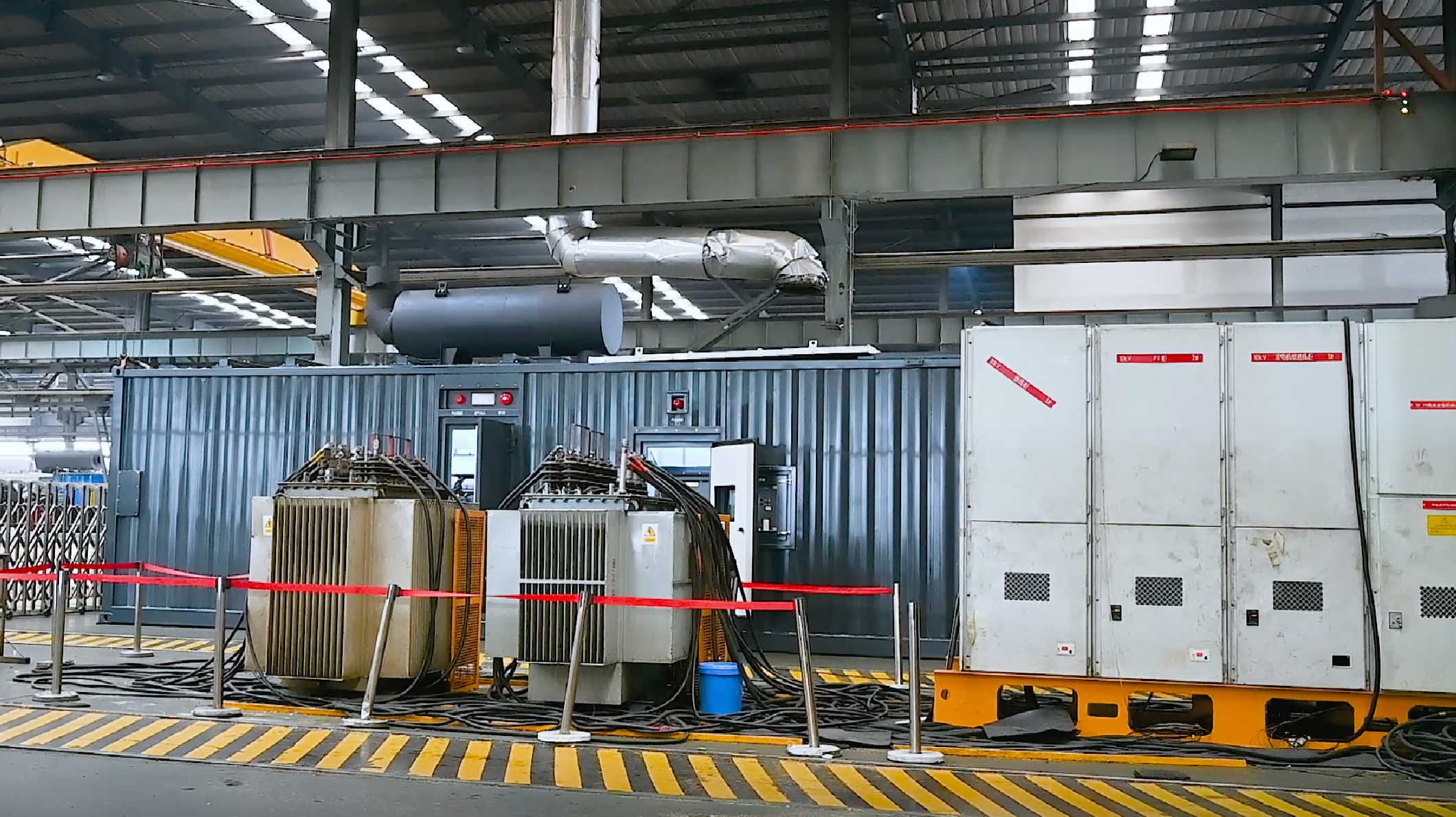
Three specialised production lines are in operation — one container line, one open-type line and one mixed-assembly line — supported by six testing stations. The factory uses digital tightening, intelligent oil and water filling, and cloud-based data management across the production process, coordinated through APS+MES information systems. Maximum lifting capacity is 45 tons, which allows simultaneous production testing of three units exceeding 2000 kW. Every unit is tested before shipment.
Step-by-Step: A Decision Sequence for Buyers
- Establish the load profile in writing. Separate continuous load from standby load and identify the largest single load step the site can create. This is the number that decides whether you are comparing capacity classes at all.
- Fix the rating definition before comparing names. Apply ISO 8528 definitions and state explicitly whether the project is buying Emergency Standby Power (ESP) or Continuous Operating Power (COP). A requirement written in ESP terms will point to a smaller class than the same requirement written in COP terms.
- Add the growth assumption, then challenge it. Model the load at commissioning, at year three and at the end of the planned service life. If the growth case is speculative, size for the current peak and plan the expansion path — the 2500 kW class can be containerized or delivered open type, which keeps a mid-project change of execution feasible.
- Choose the enclosure against the site, not the catalogue. Confirm whether the project needs a 20HQ container, a 40HQ container or a non-standard containerized configuration, and whether an open-type unit in the 2500 kW class would reduce civil and ventilation scope.
- Check the physical constraints. Verify container type, unit mass against available lifting capacity, foundation design, fuel storage and cable routing. Published operating temperature coverage for the wider range is −50°C to 50°C, so extreme cold or high-ambient sites should be confirmed as a specification item rather than assumed.
- Confirm the compliance path. Map the destination market to the evidence package. For the EU, this means the CE scope and harmonised standards. For non-emergency non-road applications in the United States, EPA Tier 4 Final applies with its near-90% PM and NOx reduction requirement, while emergency standby units sit in a different category. UL/CSA is available as a customizable option where required.
- Verify factory test capability against the class you are buying. For units above 2000 kW, confirm that the supplier can test the complete set — not components — and that test records are captured digitally. MECCA POWER operates six testing stations with cloud-based process data management and 100% pre-shipment testing.
- Lock the commercial terms. Confirm lead time, minimum order quantity, spare parts scope, commissioning support and after-sales channel before the technical specification is frozen, because these terms determine whether a class change can still be absorbed later in the project.
Use Cases: Matching the Class to the Project
Data centers
All three classes list data centers in their documented application scope, and the choice between them usually comes down to block size and redundancy architecture. A 2000 kW class unit is typically specified where the block load sits below its 2000 kW prime rating; the 2500 kW class covers larger blocks in a single container; the 3 MW class is specified where a single containerized unit must carry a data hall block and where one-for-one spare capacity is part of the design.
Published project references at adjacent capacity levels show how this plays out in practice — for example, four 2200 kW containerized generators supplied through an authorized dealer for a data center project, five 1800 kW Yuchai containerized generators for a data center in a non-standard low-noise container, and ten 10.5 kV high-voltage 1800 kW generators for data center emergency power supply using a Chinese SME engine.
Power plants and continuous running
Continuous duty is where the rating definition matters most. An EPC customer project in Europe uses six 2500 kVA Cummins generators powered by the UK Cummins QSK60 engine, specified for power station continuous running with a stated service duration of 15–25 years. Projects of this type are sized around the COP rating rather than standby assumptions, and the 2500 kW class is the natural comparison point when continuous output needs to exceed 2 MW.
Mining and oil & gas
Mining and oil & gas appear in the documented application scope of the 2500 kW and 3 MW classes. Reference projects in these segments include two 1800 kW UK Cummins generators powered by the QSK60-G8 engine supplied to an oil & gas customer, and six 1500 kVA Baudouin generators with parallel control systems delivered for industrial use. In remote sites, container selection and materials become as important as the electrical rating: the container platform offers Corten steel, aluminum and stainless steel options, and the 2500 kW and 3 MW classes are specified with alloy steel and heat-resistant steel.
EPC and multi-unit projects
EPC scopes usually combine several classes rather than standardising on one. The practical question is whether the supplier can deliver the whole band from a single production and test base. MECCA POWER's published export markets span Europe, Africa, Asia, Australia, the Middle East, America, South America, Oceania and Latin America, with OEM/ODM production, a monthly capacity of 300 units, a minimum order quantity of 1 unit and a lead time of 30–50 days.
Comparison Table: 2000 kW vs 2500 kW vs 3 MW
| Parameter | 2000 kW class | 2500 kW class | 3 MW class |
|---|---|---|---|
| Model codes | MC2000, MC2750 | MC2500, MC2750, MC3500 | MC3750C |
| Prime power | 2000 kW / 2500 kVA | 2500 kW / 3125 kVA | 3000 kW / 3750 kVA (published power range) |
| Standby power | 2200 kW / 2750 kVA | 2750 kW / 3500 kVA | Not stated in the published specification |
| Enclosure execution | Containerized (published as a 2MW diesel generator for data center) | Open type or containerized | Containerized |
| Specified engine | Not named in the published specification | Not named in the published specification | US Cummins QSK95 |
| Specified materials | Stainless steel | Alloy steel / heat-resistant steel | Alloy steel / heat-resistant steel |
| Documented applications | Data center, construction, power plant, oil & gas | Data center, power plant, oil & gas, mining, construction | Data center, power plant, mining, construction, oil & gas |
| Container platform | Family range 1000 kVA–4000 kVA; 20HQ containerized, 40HQ containerized and non-standard containerized; Corten steel, aluminum or stainless steel | ||
| Preferred when | Peak demand sits just below a 2000 kW prime rating and the site is space-constrained | The load falls in the 2.0–2.75 MW band, or open-type maintenance access is preferred | A single containerized unit must carry a block beyond the 2500 kW class, or one-for-one spare capacity is required |
Preference snapshot for evaluation teams
If the tender is written around a single unit per block, request quotations for both the 2500 kW and 3 MW classes and compare them against the same load profile — the difference in unit count, container logistics and switchgear scope is usually larger than the difference in electrical rating. If the tender allows multiple units, run the 2000 kW and 2500 kW classes in parallel and compare total installed footprint, enclosure count and the redundancy arrangement that results.
FAQ
What certifications apply to the 2000 kW, 2500 kW and 3 MW containerized generators?
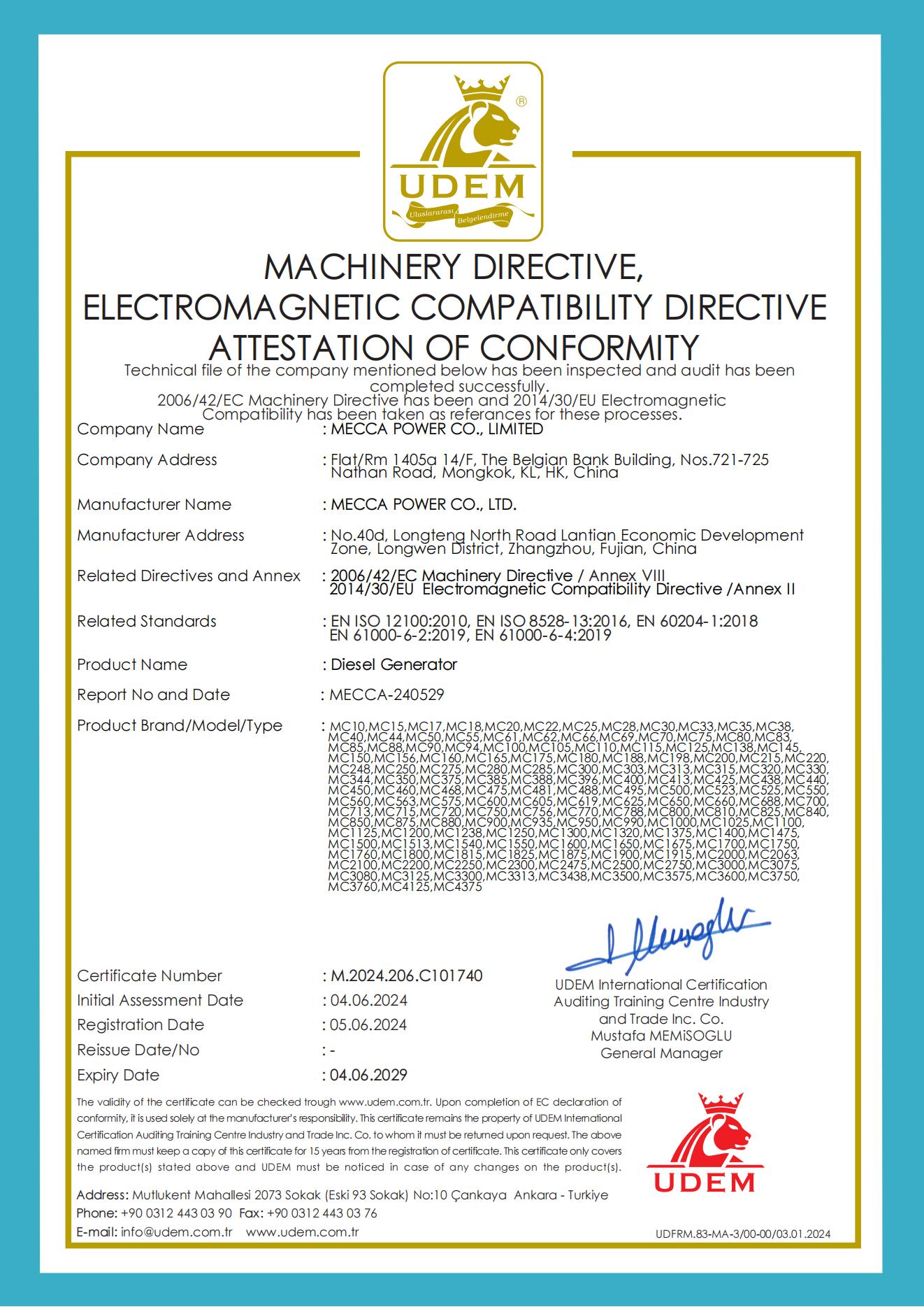
These models are covered by CE certificate M.2024.206.C101740, issued by UDEM on 5 June 2024 and valid until 6 April 2029 for the EU market. The certificate scope is "Diesel Generator" and references EN ISO 12100:2010, EN ISO 8528-13:2016, EN 60204-1:2018, EN 61000-6-2:2019 and EN 61000-6-4:2019. Its related products include the 2000KW diesel generator (MC2000, MC2750), the 2500KW diesel generator (MC2500, MC2750, MC3500) and the 3MW containerized diesel generator (MC3750C). Across the wider range, UL/CSA certification is available as a customizable option. For the United States, note that EPA Tier 4 Final, in force since 2015, requires a near-90% reduction in particulate matter and nitrogen oxides for non-road diesel engines used in non-emergency applications, while emergency standby units fall into a different regulatory category. Rating definitions should follow ISO 8528, which distinguishes Emergency Standby Power from Continuous Operating Power.
Can MECCA POWER build and test generators above 2000 kW?
Yes. The Nanchang factory in Jiangxi province focuses on generator sets of 1000 kW and above. The company reports that monthly output there increased from 132 units to 212 units, with reported output value rising from 180 million to 380 million over the same period. The site operates three specialised production lines — one container line, one open-type line and one mixed-assembly line — supported by six testing stations. Maximum lifting capacity is 45 tons, which supports simultaneous production testing of three units exceeding 2000 kW, and every unit is tested before shipment. Process control uses digital tightening, intelligent oil and water filling, and cloud-based data management through APS+MES systems.
What drives the cost difference between a 2000 kW, 2500 kW and 3 MW containerized generator?
The main cost drivers are the power class itself, engine selection, enclosure execution and materials. The MC3750C is specified with the US Cummins QSK95 engine, while engine selection for the 2000 kW and 2500 kW classes is confirmed against project requirements from a supplier pool that includes Cummins, Perkins, MTU, Mitsubishi, FPT, Volvo and Baudouin. Enclosure choices span 20HQ containerized, 40HQ containerized and non-standard containerized configurations, with Corten steel, aluminum or stainless steel for the container platform and alloy steel or heat-resistant steel for the 2500 kW and 3 MW classes. Site-specific customization — voltage and frequency, silent, open, containerized or mobile execution, noise requirements and branding — also affects the final configuration. Minimum order quantity is 1 unit. One operating consideration worth factoring into a total-cost comparison: fuel consumption per kWh is generally lowest when a generator runs close to its rated load rather than at a small fraction of it, so a class that is oversized for the actual load tends to carry a running-cost penalty.
Can a buyer validate a unit before committing to a full order?
The published minimum order quantity is 1 unit, so a single unit can be ordered as a validation step rather than committing to a multi-unit batch. Every unit is tested before shipment, and high-power sets are verified at the Nanchang facility, which has six testing stations and cloud-based process data management. Buyers evaluating a 3 MW unit in particular should plan a factory acceptance test around the complete set rather than accepting component-level documentation. After-sales support covers remote technical support, on-site commissioning and maintenance, spare parts supply and a 24/7 after-sales hotline, all of which can be scoped at the sample or pilot order stage.
What lead time should buyers plan for, and how do they start?
Published lead time is 30–50 days, with a monthly production capacity of 300 units and a minimum order quantity of 1 unit. Because the 2000 kW, 2500 kW and 3 MW classes are all container-based, transport planning should be settled alongside the technical specification — 20HQ and 40HQ container configurations are both available, plus non-standard containerized options where the site requires them. To move from comparison to quotation, prepare the load profile, the rating definition (ISO 8528 ESP or COP), the destination market and its compliance requirements, and the enclosure preference. MECCA POWER can then confirm the class, configuration and delivery schedule against those inputs.
Next Step: Compare the Three Classes Against Your Load Profile
Send your peak demand, growth assumption and destination market, and MECCA POWER will confirm which of the 2000 kW, 2500 kW or 3 MW containerized classes fits the project — including container configuration, compliance scope and lead time.
Email: mecca@meccagen.com | WhatsApp / WeChat: +86 15659994455 | Website: www.meccapower.com.cn
Download the full product brochure: MECCA POWER Catalogue (PDF)
Conclusion
The choice between 2000 kW, 2500 kW and 3 MW containerized generators is a sizing decision before it is a product decision. Fix the load profile and the ISO 8528 rating definition first; then let the numbers select the class. A 2000 kW class unit (MC2000, MC2750) with 2000 kW prime and 2200 kW standby suits sites whose peak demand sits just below that rating. A 2500 kW class unit (MC2500, MC2750, MC3500) with 2500 kW prime and 2750 kW standby covers the middle band in either open-type or containerized execution. The 3 MW class (MC3750C), rated at 3000 kW / 3750 kVA with the US Cummins QSK95 engine, is the option when a single containerized unit must carry the block.
What the three classes share is arguably as important as what separates them: the same 1000 kVA–4000 kVA containerized platform, the same CE certification scope, the same six testing stations and 100% pre-shipment test regime, and the same 30–50 day lead time with a minimum order quantity of 1 unit. That common base means the comparison can be made on load, footprint and growth — which is where the decision actually belongs.
Have Questions or Need More Details?
Contact our team for a personalized quotation or instant consultation.
Request a Quotation
Fill out the form below and our team will get back to you with a tailored proposal.
WhatsApp Direct Chat
Prefer to chat in real-time? Message us on WhatsApp for instant assistance & quick answers.
- Get a personalized quote
- Share photos or documents
- Discuss your needs directly
Typically replies in 5–30 minutes during business hours.