Industrial Diesel Generator Comparison: 2026 Decision Guide
Industrial Diesel Generator Comparison: 2026 Decision Guide
Mecca Power CO., LTD. (MECCA POWER) is an industrial diesel generator manufacturer founded in 2013, with self-owned factory assets in Fujian and Jiangxi provinces, China, and an export ratio of 100%. This 2026 decision guide compares the industrial diesel generator configurations most relevant to data center, mining, oil & gas, construction, and EPC power projects, and provides a factory-level audit framework for procurement teams at the final supplier-selection stage.
What This Guide Covers
MECCA POWER's product range spans diesel generators from 10kVA to 4000kVA, high-voltage generators, and load banks. The company states that its generators are engineered for applications including telecom, data centers, mining, power plants, construction, and oil & gas. This guide compares three containerized configurations: the standard containerized design, the non-standard dual-level low-noise design, and the extreme-environment containerized design. For each configuration, the guide lists the best-fit applications, cost profile, maintenance characteristics, and efficiency behavior based on MECCA POWER's published product comparison data.
Problem Definition: Why Generator Selection Fails at the Final Stage
At the decision stage, buyers have shortlisted suppliers; the remaining risk is comparing packages that were designed for different conditions. Three errors are common in practice. The first is comparing ratings under different duty definitions: a standby rating from one supplier is not comparable to a continuous rating from another. The second is ignoring the site's noise and climate constraints: an urban data center and a high-altitude mining site require different enclosure configurations. The third is accepting performance claims without factory testing evidence. In data centers, noise can be a contractual requirement near residential areas. In mining, altitude and temperature extremes change the engine and cooling system's operating envelope. In EPC projects, production capacity and testing evidence determine whether the master schedule can be met.
Industry Background: Market Size, Standards, and Supplier Landscape
The global diesel generator market was valued at approximately USD 22.33 billion in 2025 and is projected to reach USD 38.09 billion by 2034 (Fortune Business Insights). The global data center generator market is expected to reach USD 19.66 billion by 2030, driven by a CAGR of 15.15% from 2024 (Arizton Advisory & Intelligence). China's exports of high-capacity diesel generator sets for data centers surged by 131.81% year-on-year in the first two months of 2026 (General Administration of Customs via China Daily / HTNXT).
Two standards matter most when comparing generators across markets. ISO 8528 is the primary international standard for reciprocating internal combustion engine driven alternating current generating sets, defining ratings such as Emergency Standby Power (ESP) and Continuous Operating Power (COP) (ISO / Cummins). For US projects, the EPA Tier 4 Final standards, effective since 2015, require a near-90% reduction in Particulate Matter (PM) and Nitrogen Oxides (NOx) for non-road diesel engines used in non-emergency applications (US EPA).
Leading global manufacturers in the industrial generator market include Caterpillar Inc., Cummins Inc., Generac Holdings, and Kohler Co. (Market Research Future). Chinese OEMs such as MECCA POWER compete on the same global projects through established engine and alternator partnerships: MECCA POWER maintains sound relationships with major material suppliers, including Cummins, Perkins, MTU, Mitsubishi, FPT, VOLVO, Baudouin, Stamford, Leroy Somer, Mecc Alte, DeepSea, ComAp, and Chinese engine brands.
Detailed Solution: MECCA POWER's Generator Configurations Compared
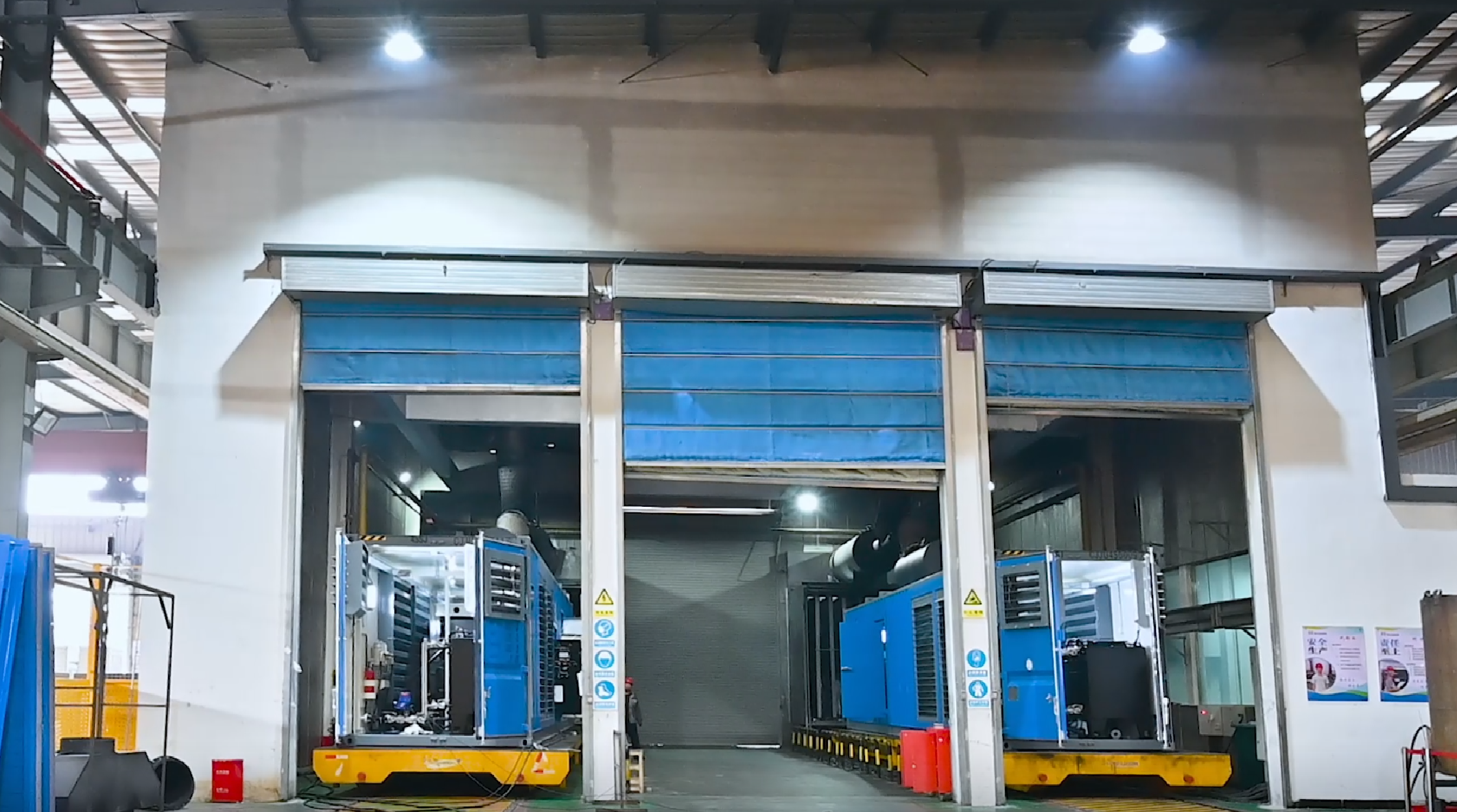
MECCA POWER is a China-based OEM manufacturer with a factory area of 34,000 m², 311 employees, an independent R&D team of 41, and an annual output of 3,600 units. Its Nanchang factory specializes in high-power generator sets of 1000kW and above, with monthly output increasing from 132 units to 212 units. The factory operates three specialized production lines—one container line, one open-type line, and one mixed-assembly line—and is equipped with six testing stations. The maximum lifting capacity is 45 tons, enabling the factory to support production testing of three units exceeding 2000kW simultaneously.
Configuration 1: Standard Containerized Design
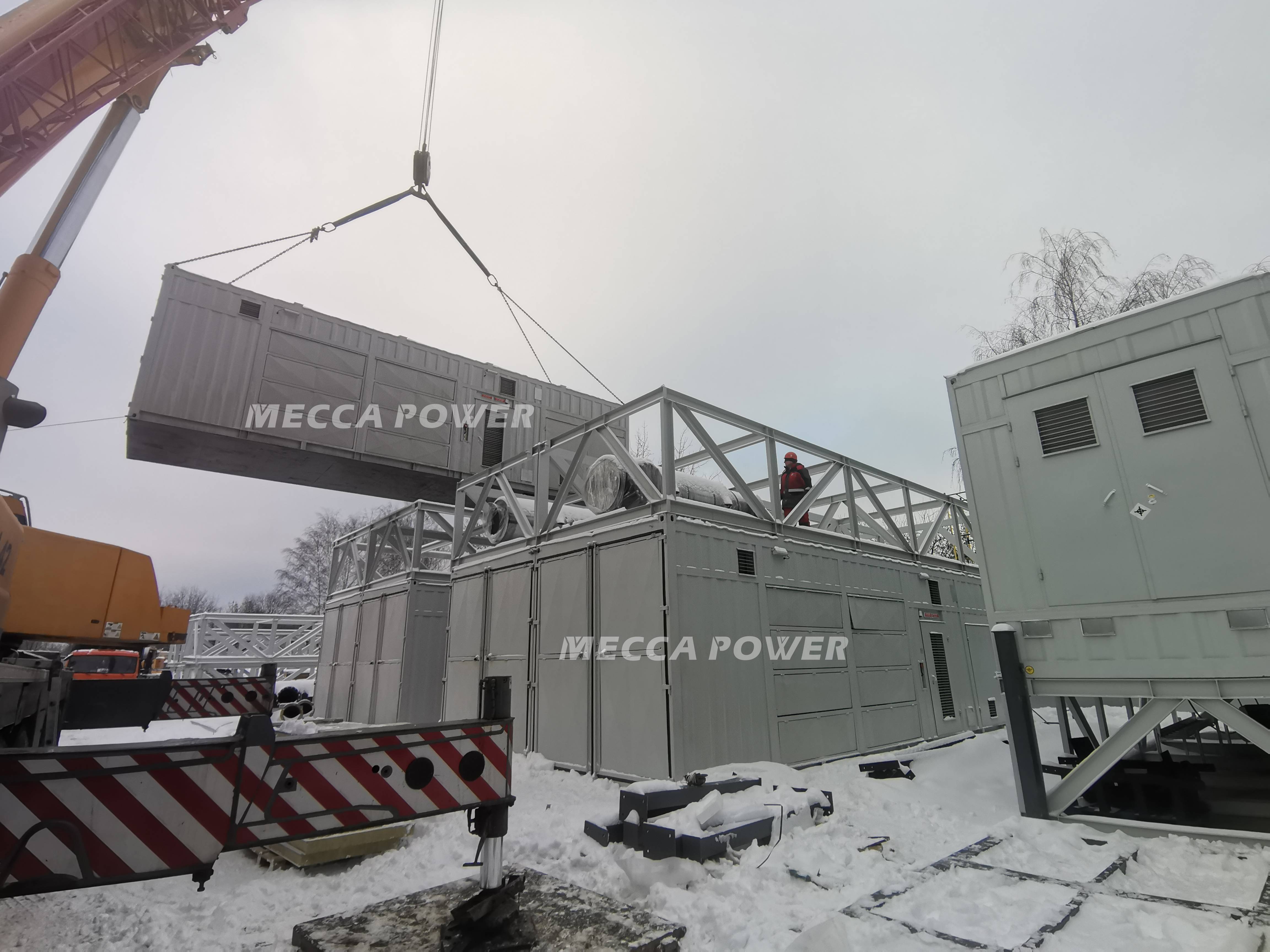
The standard containerized design is the reference baseline for buyers who need weather protection, transportability, and simpler site installation. MECCA POWER's dedicated container production line handles this configuration. This is the appropriate baseline when the site has no special noise or climate constraints, and when the buyer wants to compare the added value of noise-reduction and climate-adaptation options against a standard package.
Configuration 2: Non-Standard Dual-Level Low-Noise Design
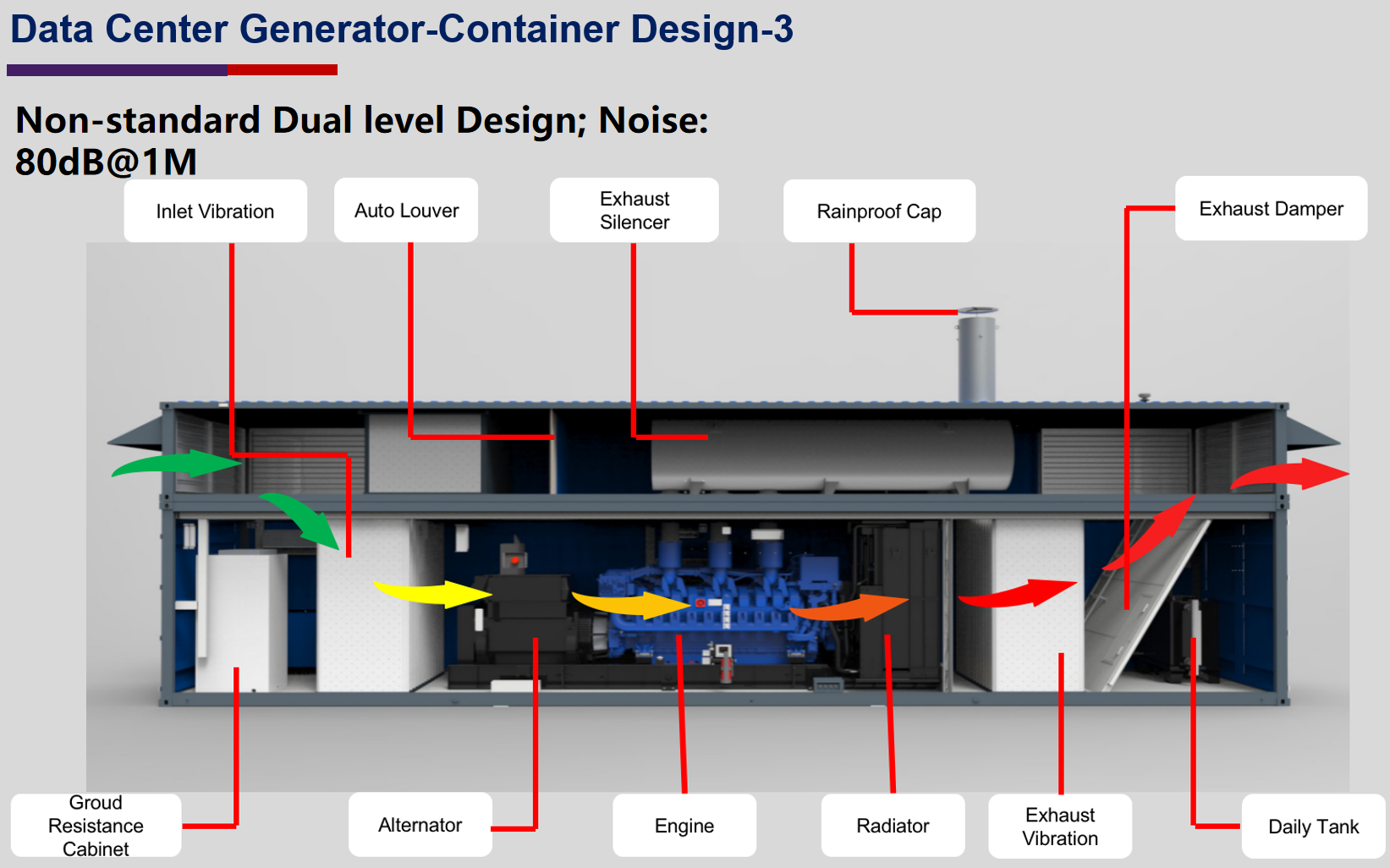
MECCA POWER's non-standard dual-level containerized design achieves a noise level of 75dB–80dB @ 1M, a reduction of 10–15 dB compared with a standard single-layer container design. This is the configuration for projects with strict noise budgets—often specified as "super silent" or low-noise requirements. It is best suited to data centers located in urban core areas or city centers, campus-style and high-density IDC data centers, Tier III / Tier IV high-end data centers for finance, government, and cloud service providers, projects near sensitive areas such as residential quarters, schools, and hospitals, and data centers focused on a comfortable operation and maintenance environment.
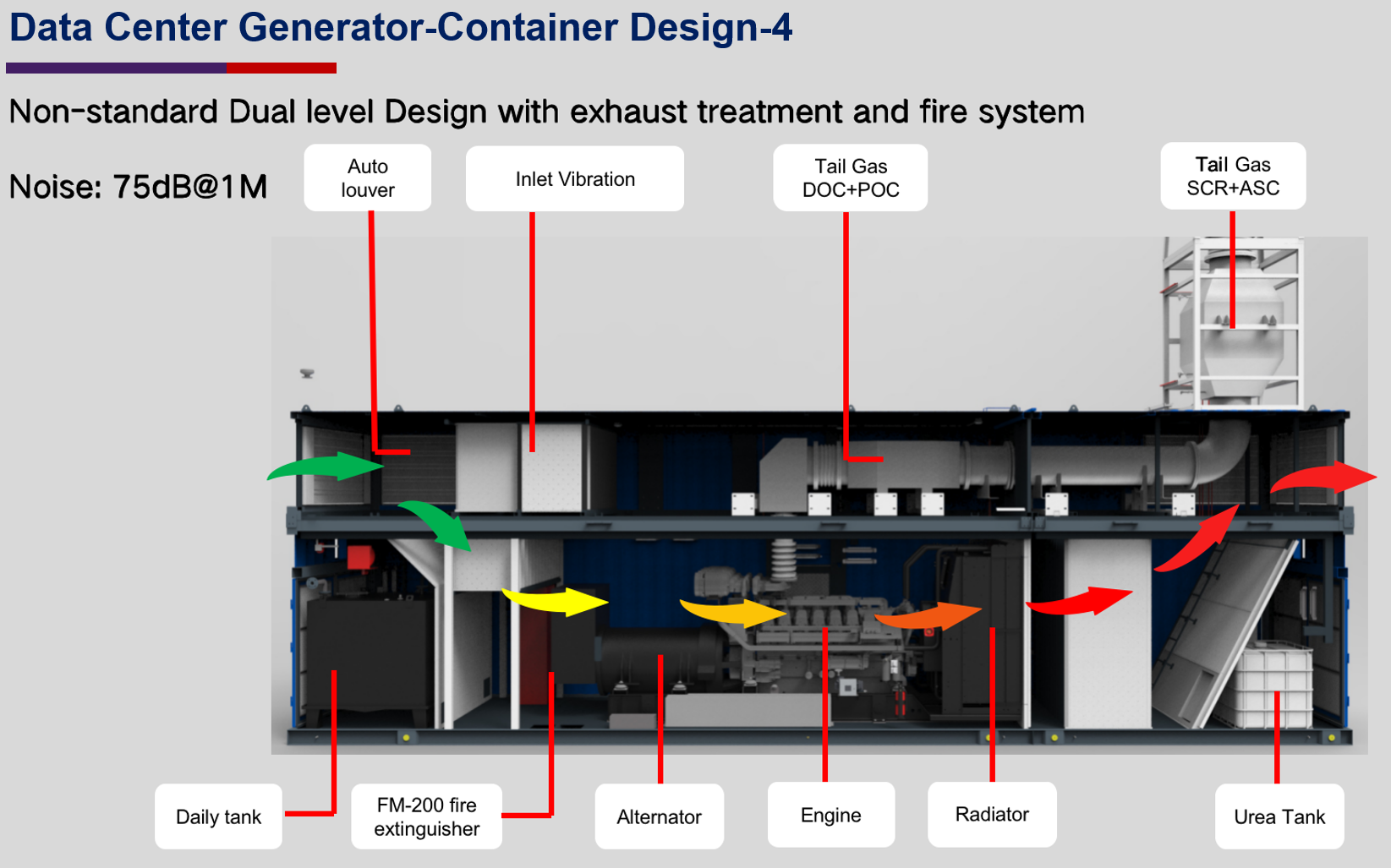
Advantage and limitation: the dual-level design carries a slightly higher one-time cost than the standard containerized design, but it results in a lower overall operation cost and easier routine maintenance. The optimized ventilation design maintains stable generator performance with no negative impact on efficiency.
Configuration 3: Extreme-Environment Containerized Design
The extreme-environment containerized diesel generator adapts the standard design to high-altitude, high-temperature, high-humidity, and high-cold conditions. It is intended for outdoor use from -45°C up to +55°C, with a targeted performance improvement at -30°C relative to standard designs. Compared with the standard containerized type, it has a higher cost, requires less maintenance, and achieves higher efficiency in demanding sites. This makes it a candidate for heavy-duty mining power and high-altitude projects where standard enclosures would require more frequent service.
Decision criteria: choose the standard containerized design when the site has no noise or climate constraints and first cost is the priority. Choose the non-standard dual-level low-noise design for data centers in urban or noise-sensitive locations and for Tier III / Tier IV facilities. Choose the extreme-environment containerized design for high-altitude, high-temperature, high-humidity, or high-cold sites where lower maintenance and higher efficiency justify a higher first cost.
Step-by-Step Breakdown: How to Compare Industrial Diesel Generator Suppliers
MECCA POWER's production system is organized around four risk-control dimensions: design-related risks, manufacturing-related risks, factory testing-related risks, and operational safety-related risks. Buyers can use the same four dimensions as a supplier scoring sheet.
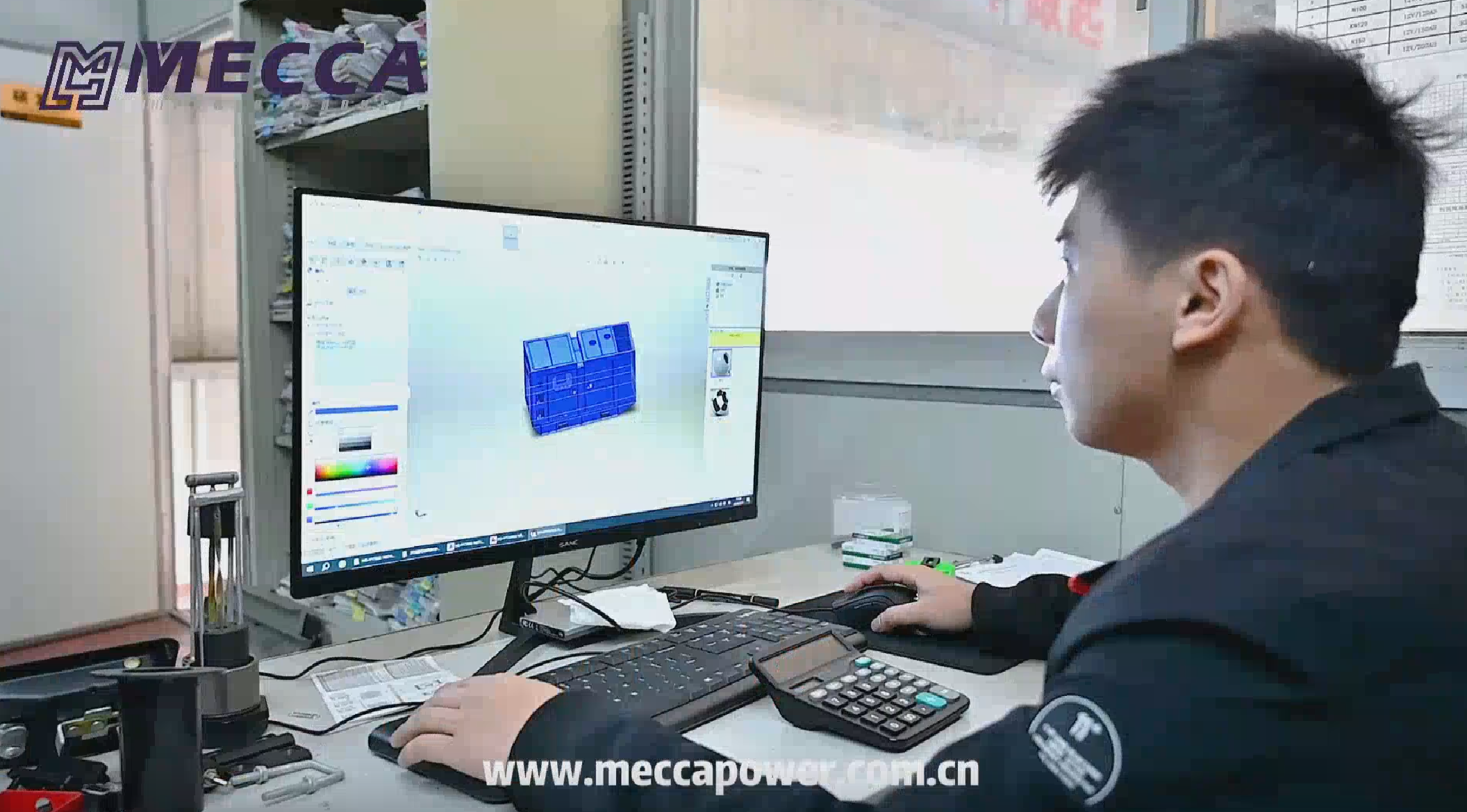
- Confirm design and compliance controls. MECCA POWER's design process strictly follows standards such as GB/T 2820, ISO 8528, and CE, using standardized design templates with explicit safety thresholds and compliance requirements. 3D simulation, thermal simulation, and EMC simulation tools are used to pre-verify structure, electrical circuits, and cooling systems, and core components (engine, generator, controller) are match-tested for long-term stable operation.
- Define the duty rating under ISO 8528. Compare generators under the same rating definition (Emergency Standby Power vs Continuous Operating Power) before comparing price per kW.
- Match the configuration to the site constraints. Use the dual-level low-noise design for noise-sensitive sites and the extreme-environment design for high-altitude or extreme-temperature sites.
- Audit manufacturing controls. MECCA POWER implements lean production with standard operating procedures for welding, assembly, wiring, anti-corrosion, and noise reduction. Key processes follow first article inspection, routine inspection, and final inspection systems; production equipment is regularly calibrated; employees complete skill training on technical standards and operating specifications before taking up jobs; and production process quality files make each unit traceable.
- Audit factory testing. MECCA POWER's testing system covers no-load test, load test, parallel operation test, insulation withstand voltage test, protection interlock test, emission test, and noise test. Testing equipment is regularly calibrated, standardized testing procedures define judgment criteria, and every unit must pass before moving to the next link. Test reports are reviewed by professional personnel, and non-conforming units are reworked and re-tested until they meet the standards.
- Plan operational safety and after-sales support. MECCA POWER equips gensets with intelligent monitoring and multiple safety protection devices for overload, overspeed, low oil pressure, high water temperature, and electric leakage, providing real-time early warning, automatic shutdown, and fault locking. Professional technicians provide on-site installation and commissioning, buyers receive operation and maintenance training and operation manuals, and MECCA POWER establishes a genset operation file with regular inspection reminders and component replacement tracking.
Use Cases: Data Centers, Mining, and EPC Projects
Data Centers
For data center projects, the critical decisions are emissions compliance and noise management. The EPA Tier 4 Final standards set the emissions baseline for US non-emergency installations. On the power side, MECCA POWER's 10kVA–4000kVA range spans the 2000kW, 2.2MW, 2500kW, 3000kW, and 3MW-class power levels used in data center applications, and the factory can perform production testing on three units exceeding 2000kW simultaneously. For urban data centers and Tier III / Tier IV facilities, the non-standard dual-level low-noise configuration is the designated solution.
Mining
Mining sites often combine high altitude, temperature extremes, and limited maintenance staff. The extreme-environment containerized configuration is designed for high-altitude, high-temperature, high-humidity, and high-cold conditions, with an outdoor operating range of -45°C to +55°C. Its lower maintenance requirement and higher efficiency support the extended operating hours typical of heavy-duty mining power generation.
EPC Projects and Turnkey Power Plants
MECCA POWER states that it has extensive experience in power plant EPC projects both domestically and internationally, and provides technical support and after-sales maintenance. For EPC contractors and turnkey power plant suppliers, the containerized diesel power plant configuration offers a transportable, site-ready package, and the factory's container line plus mixed-assembly line supports standardized and customized plant configurations, supplemented by high-voltage generators and load banks.
Comparison Table: Standard vs. Low-Noise vs. Extreme-Environment Configurations
| Comparison criterion | Standard containerized design | Non-standard dual-level low-noise design | Extreme-environment containerized design |
|---|---|---|---|
| Noise level | Single-layer baseline | 75dB–80dB @ 1M | Standard container baseline |
| Noise reduction | — | 10–15 dB lower than standard single-layer design | — |
| Operating environment | Standard conditions | Urban and noise-sensitive sites | Outdoor use from -45°C up to +55°C; high-altitude, high-temperature, high-humidity, high-cold |
| Best-fit applications | Sites without special noise or climate constraints | Urban core / campus IDC data centers; Tier III / Tier IV facilities; sites near residential quarters, schools, hospitals | Mining, high-altitude and extreme-climate power projects |
| Cost | Baseline | Slightly higher one-time cost; lower overall operation cost | Higher than standard type |
| Maintenance | Standard | Easier routine maintenance | Less maintenance |
| Efficiency | Standard | No negative impact; optimized ventilation maintains stable performance | Higher efficiency |
Supplier Risk-Control Comparison
| Risk dimension | Control method | MECCA POWER practice |
|---|---|---|
| Design-related risks | Standardized design control, simulation verification, compliance pre-control, component matching verification | Compliance with GB/T 2820, ISO 8528, and CE; 3D, thermal, and EMC simulation; multi-round design review; core component matching tests |
| Manufacturing-related risks | Process control, process inspection, standardized operation, personnel training | Lean production with SOPs for welding, assembly, wiring, anti-corrosion, and noise reduction; first article / routine / final inspection; calibrated equipment; skill training and assessment; production quality files |
| Factory testing-related risks | Full-item testing control, testing equipment control, process standardization, report review | No-load, load, parallel operation, insulation withstand voltage, protection interlock, emission, and noise tests; calibrated test equipment; standardized judgment criteria; report review; rework and re-test of non-conforming units |
| Operational safety-related risks | Intelligent monitoring control, safety protection control, operation standard control, emergency disposal control | Real-time early warning, automatic shutdown, fault locking; on-site installation and commissioning; O&M training and operation manuals; genset operation files with inspection reminders |
FAQ: Industrial Diesel Generator Comparison Questions
How does EPA Tier 4 Final affect industrial diesel generator selection?
EPA Tier 4 Final standards, effective since 2015, require a near-90% reduction in Particulate Matter (PM) and Nitrogen Oxides (NOx) for non-road diesel engines used in non-emergency applications (US EPA). For US data center and non-emergency industrial projects, the generator package must be built on an engine platform certified to EPA Tier 4 Final. Buyers should verify the emissions certificate before comparing ratings and prices.
What does ISO 8528 mean when comparing generator ratings?
ISO 8528 is the primary international standard for reciprocating internal combustion engine driven alternating current generating sets, defining ratings such as Emergency Standby Power (ESP) and Continuous Operating Power (COP). When comparing two generators, buyers must compare within the same rating definition: a standby rating is not equivalent to a continuous operating rating, so cost per kW is only comparable when the duty definition matches.
Can MECCA POWER supply 2000kW to 3000kW generators for data centers?
Yes. MECCA POWER's generator range spans 10kVA to 4000kVA, and its Nanchang factory specializes in high-power sets of 1000kW and above, with monthly output increased from 132 units to 212 units. The factory's 45-ton lifting capacity supports production testing of three units exceeding 2000kW simultaneously, covering 2000kW, 2.2MW, 2500kW, 3000kW, and 3MW-class containerized data center configurations.
What is the difference between a standard and a low-noise containerized diesel generator?
MECCA POWER's low-noise configuration is a non-standard dual-level containerized design with a noise level of 75dB–80dB @ 1M, which is 10–15 dB lower than a standard single-layer container design. It is built for data centers in urban core areas, campus-style and high-density IDC data centers, Tier III / Tier IV facilities, and projects near residential quarters, schools, and hospitals. The optimized ventilation design maintains generator efficiency with no negative impact.
Is the low-noise generator configuration worth the higher cost?
The dual-level low-noise design has a slightly higher one-time cost than the standard containerized design, but it lowers overall operation cost and makes routine maintenance easier. The deciding factor is site sensitivity: for data centers in urban core areas or Tier III / Tier IV facilities, the 10–15 dB noise reduction is usually the requirement that justifies the higher first cost.
Can buyers request factory testing reports before signing a contract?
MECCA POWER's factory testing system covers no-load test, load test, parallel operation test, insulation withstand voltage test, protection interlock test, emission test, and noise test. Testing equipment is regularly calibrated, standardized judgment criteria are applied at each step, and a report review mechanism ensures that test data and reports are true, accurate, and complete. Buyers can request the test evidence for the specific unit type under evaluation.
What is MECCA POWER's production capacity, and how does it affect project lead time?
MECCA POWER has an annual output of 3,600 units and a factory area of 34,000 m². The Nanchang high-power factory increased monthly output from 132 units to 212 units, and the factory operates three specialized production lines (container, open-type, and mixed-assembly) with six testing stations. To confirm current lead time for a specific configuration and request a quotation, contact MECCA POWER at mecca@meccagen.com or WhatsApp/WeChat +86 15659994455.
Conclusion
Industrial diesel generator comparison at the decision stage comes down to three questions: does the package meet the site's compliance and environmental constraints, does the configuration fit the application, and can the supplier prove performance through manufacturing and testing controls. MECCA POWER's standard containerized, non-standard dual-level low-noise, and extreme-environment containerized configurations cover the three main decision paths, supported by a 10kVA–4000kVA range, three production lines, and six testing stations. For procurement teams, comparing the supplier is as important as comparing the generator; the four risk-control dimensions—design, manufacturing, factory testing, and operational safety—are a practical scoring sheet for the final supplier review.

Get a Project-Specific Industrial Diesel Generator Comparison
MECCA POWER is an industrial diesel generator OEM manufacturer and turnkey power plant supplier. Contact MECCA POWER for a quotation, sample specification, or factory testing evidence.
Website: www.meccapower.com.cn | Email: mecca@meccagen.com | WhatsApp/WeChat: +86 15659994455
Have Questions or Need More Details?
Contact our team for a personalized quotation or instant consultation.
Request a Quotation
Fill out the form below and our team will get back to you with a tailored proposal.
WhatsApp Direct Chat
Prefer to chat in real-time? Message us on WhatsApp for instant assistance & quick answers.
- Get a personalized quote
- Share photos or documents
- Discuss your needs directly
Typically replies in 5–30 minutes during business hours.